
Disperseur hydraulique à double arbre : principe de fonctionnement, applications et guide de sélection
Introduction
Lorsque vous travaillez avec des matériaux à haute viscosité tels que des peintures, des adhésifs, des encres ou des pâtes pour batteries, vous êtes souvent confronté à un défi commun : obtenir un mélange et une dispersion efficaces sans temps de traitement excessif ni usure de l'équipement. Un disperseur à arbre unique peut avoir du mal à traiter des matériaux au-dessus d'une certaine plage de viscosité, ce qui entraîne une mauvaise dispersion, la formation de vortex et des cycles de production lents. C'est là qu'un disperseur hydraulique à double arbre devient une solution pratique.
Cet article explique ce qu'est un disperseur hydraulique à double arbre, comment il fonctionne, où il est couramment utilisé et quels facteurs vous devez prendre en compte lors de la sélection d'un disperseur pour votre ligne de production. Que vous soyez ingénieur procédés ou responsable des achats, comprendre ces points vous aidera à prendre une décision plus éclairée.
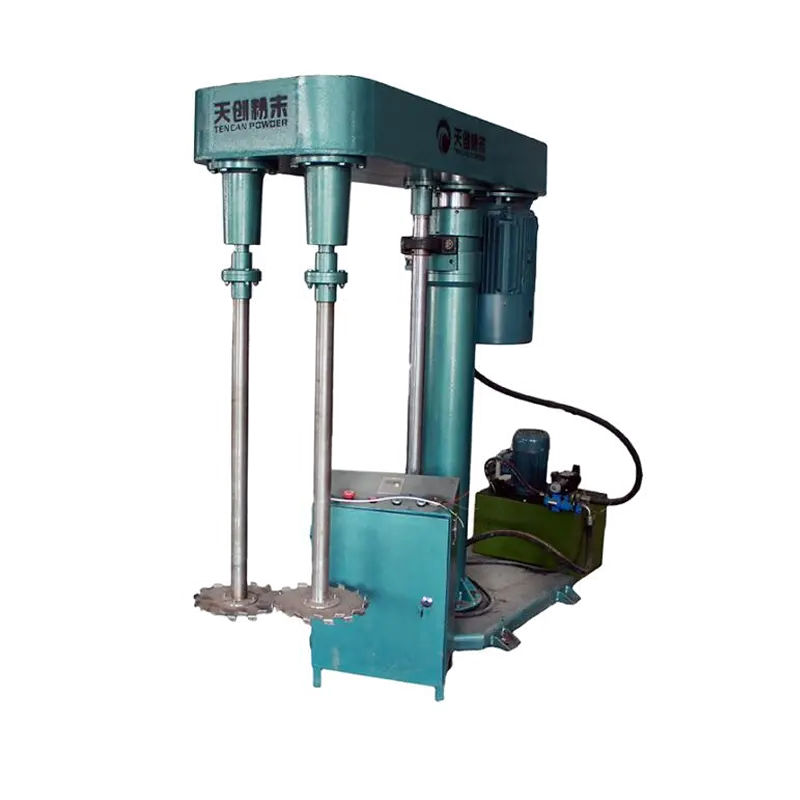
Qu'est-ce qu'un disperseur hydraulique à double arbre ?
Un disperseur hydraulique à double arbre est un type d’équipement de mélange et de dispersion qui combine deux arbres agitateurs indépendants au sein d’une seule machine. Un arbre fonctionne généralement à une vitesse inférieure, équipé d'une lame hélicoïdale ou de type ancre pour le mélange et le grattage en vrac, tandis que l'autre arbre fonctionne à une vitesse élevée et est équipé d'un disque de dispersion dentelé pour un cisaillement intensif et une réduction de la taille des particules. L'ensemble de l'ensemble de mélange est monté sur un système de levage hydraulique, permettant aux agitateurs d'être facilement levés et abaissés dans la cuve de mélange.
Cette conception offre plusieurs avantages par rapport aux disperseurs à arbre unique:
- Efficacité de mélange améliorée pour les matériaux de viscosité moyenne à élevée (jusqu'à environ 50 000 cps ou plus, selon le modèle).
- Temps de traitement réduit car les deux arbres travaillent simultanément pour déplacer le matériau à la fois axialement et radialement.
- Meilleure qualité de dispersion en raison de la combinaison d'un écoulement massif et de zones à fort cisaillement.
- Levage hydraulique simplifie le nettoyage, le changement de récipient et la gestion des lots.
Comment fonctionne un disperseur hydraulique à double arbre ?
Le principe de fonctionnement d’un disperseur hydraulique à double arbre est relativement simple mais efficace. L'arbre à basse vitesse, souvent appelé arbre mélangeur ou racleur, tourne à une vitesse de plusieurs dizaines à quelques centaines de tr/min. Il pousse le matériau des parois et du fond de la cuve vers le centre, garantissant qu'aucun matériau ne reste stagnant. Ce mouvement en vrac contribue également à alimenter le matériau dans le disque de dispersion à grande vitesse.
L'arbre à grande vitesse, généralement entraîné par un moteur séparé, peut atteindre des vitesses de 1 000 tr/min ou plus, selon le matériau et l'application. Le disque de dispersion, souvent une roue dentée ou en dents de scie, crée un fort champ de cisaillement. Lorsque le disque tourne, il génère un vortex qui attire le matériau vers le bas et radialement vers l'extérieur, brisant les agglomérats et réduisant la taille des particules grâce à un cisaillement hydraulique intense, une collision et une friction.
La combinaison du mélange en vrac à faible vitesse et de la dispersion à grande vitesse est particulièrement efficace pour les matériaux thixotropes ou ayant tendance à former des grumeaux. Par exemple, lors de la préparation de pâtes de noir de carbone, les pales à basse vitesse aident à incorporer la poudre sèche dans la phase liquide, tandis que le disque à grande vitesse décompose rapidement les agglomérats pour obtenir une fine dispersion.
Applications clés des disperseurs hydrauliques à double arbre
Les disperseurs hydrauliques à double arbre sont largement utilisés dans les industries où des dispersions à haute viscosité sont requises. Certaines des applications les plus courantes incluent:
Peintures et revêtements
Dans l’industrie de la peinture, la production d’une dispersion uniforme des pigments est essentielle à la cohérence et à la brillance des couleurs. Un disperseur à double arbre peut gérer la viscosité élevée des bases de broyage, mouillant efficacement les pigments et réduisant les agglomérats avant que le matériau ne soit traité davantage dans un broyeur à billes ou un autre équipement.
Encres et pâtes d'impression
Les encres contiennent souvent de fortes concentrations de pigments et de liants, ce qui donne une consistance pâteuse. La conception à double arbre permet une pré-dispersion efficace, réduisant le nombre de passages requis dans un broyeur et améliorant le débit de production.
Adhésifs et mastics
De nombreuses formulations adhésives, telles que les produits à base de polyuréthane ou de silicone, ont une viscosité élevée et nécessitent un mélange minutieux de charges, d'épaississants et d'additifs. Le disperseur hydraulique à double arbre peut traiter ces matériaux avec un minimum d'emprisonnement d'air, ce qui est important pour la qualité du produit final.
Pâtes pour batteries (Lithium-ion et Plomb-acide)
Les pâtes d'électrodes pour batteries sont généralement des mélanges à haute viscosité de matériaux actifs, d'additifs conducteurs et de liants. Le disperseur à double arbre fournit le cisaillement nécessaire pour briser les agglomérats tout en maintenant une suspension uniforme, ce qui est essentiel pour un revêtement d'électrode et des performances de batterie cohérents.
Cosmétiques et soins personnels
Les produits comme les crèmes, les lotions et les dentifrices nécessitent souvent un mélange doux mais efficace pour incorporer des épaississants et des ingrédients actifs. La lame à basse vitesse peut être conçue avec un grattoir pour éviter toute accumulation sur les parois du récipient, tandis que le disque à grande vitesse assure une texture lisse et homogène.
Comment sélectionner le bon disperseur hydraulique à double arbre
Le choix du disperseur hydraulique à double arbre approprié pour votre ligne de production implique plusieurs considérations. Vous trouverez ci-dessous les facteurs clés que vous devez évaluer avant de faire un achat.
Viscosité et rhéologie des matériaux
La plupart des disperseurs hydrauliques à double arbre sont conçus pour des matériaux dont la viscosité peut atteindre 50 000 cps environ, mais certains modèles robustes peuvent gérer des valeurs encore plus élevées. Si votre matériau est extrêmement thixotrope ou présente une limite d'élasticité élevée, un entraînement plus puissant et une lame à basse vitesse spécialement conçue peuvent être nécessaires. Il est toujours conseillé de discuter de votre matériel spécifique avec le fournisseur d'équipement pour confirmer la conception appropriée.
Taille du lot et volume du récipient
Les disperseurs hydrauliques à double arbre sont disponibles dans une large gamme de capacités, depuis les unités de laboratoire traitant 50 litres jusqu'aux machines industrielles d'une capacité de 10 000 litres ou plus. Vous devez sélectionner un modèle dont le volume de travail correspond à la taille typique de votre lot. Le système de levage hydraulique permet d'adapter les agitateurs à différentes hauteurs de cuve, mais il est important de s'assurer que le diamètre et la profondeur de la cuve se situent dans la plage recommandée pour des modèles d'écoulement optimaux.
Nombre et configuration des agitateurs
Alors que la configuration standard est composée de deux arbres (un à basse vitesse, un à grande vitesse), certaines machines peuvent être équipées de disques de dispersion supplémentaires ou d'un troisième arbre pour un mélange encore plus intensif. Le choix dépend de la difficulté de traitement de votre matériau. Par exemple, si vous devez disperser des particules très fines ou obtenir une distribution granulométrique étroite, une vitesse de pointe plus élevée sur le disque de dispersion peut être bénéfique.
Matériau de construction (pièces en contact avec le produit)
Les pièces qui entrent en contact avec le produit doivent être constituées de matériaux compatibles avec votre formulation. L'acier inoxydable (SS304 ou SS316) est courant pour les matériaux aqueux et de nombreux matériaux à base de solvants. Pour les produits abrasifs ou corrosifs, de l'acier trempé ou des revêtements spéciaux peuvent être nécessaires. Le vérin hydraulique et le châssis sont généralement en acier au carbone avec une finition de peinture protectrice.
Contrôle de vitesse et puissance du moteur
La plupart des disperseurs hydrauliques à double arbre utilisent des variateurs de fréquence (VFD) pour le contrôle de vitesse variable sur les deux arbres. Cela vous permet d'ajuster l'intensité du mélange pour différentes étapes du processus. La puissance du moteur requise dépend de la viscosité et de la taille du lot. À titre indicatif, une unité de laboratoire de 50 litres peut utiliser un moteur à grande vitesse de 1,5 kW, tandis qu'une unité industrielle de 1 000 litres peut nécessiter un moteur de 30 kW ou plus. Consultez le fabricant pour des recommandations spécifiques.
Caractéristiques de sécurité et facilité d'utilisation
Recherchez des fonctionnalités telles que des boutons d'arrêt d'urgence, des verrouillages de sécurité qui empêchent la machine de fonctionner lorsque le navire n'est pas en position et une protection contre les surcharges. Un système hydraulique bien conçu doit se lever et s’abaisser en douceur, sans fuite. Un accès facile au panneau de commande et un affichage clair de la vitesse, de la minuterie et d'autres paramètres améliorent le confort de l'opérateur.
Considérations importantes pour l'achat
Lorsque vous contactez un fournisseur pour un devis, il est utile de préparer les informations suivantes afin qu'il puisse vous recommander le modèle le plus approprié.:
- Nom et composition du matériau
- Plage de viscosité (cps ou Pa·s)
- Taille du lot (litres ou gallons)
- Température de traitement (si différente de la température ambiante)
- Taille finale des particules ou qualité de dispersion souhaitée
- Tension et fréquence requises (par exemple, 380 V/50 Hz ou 480 V/60 Hz)
- Toute exigence particulière (par exemple, couverture antidéflagrante, sous vide ou par gaz inerte)
La fourniture de ces détails aidera le fournisseur à configurer la machine avec la puissance du moteur, la plage de vitesse de l'arbre, la conception de la lame et le matériau de construction corrects.
Disperseur hydraulique à double arbre par rapport aux autres équipements de mélange
Il est également utile de comprendre comment un disperseur hydraulique à double arbre se compare aux autres types d'équipements de mélange disponibles sur le marché. Par exemple, si votre matériau est de faible viscosité (inférieure à 5 000 cps), un disperseur simple à grande vitesse peut être suffisant et plus rentable. Pour les pâtes très visqueuses ou les matériaux pâteux, un pétrin sous vide pourrait être un meilleur choix. Pour le mélange de poudre sèche, un Mélangeur de type V ou mélangeur à double cône est plus approprié.
Le disperseur hydraulique à double arbre occupe un emplacement idéal pour les dispersions liquides de viscosité moyenne à élevée où l'agitation et le cisaillement sont nécessaires. Il ne s'agit pas d'une solution universelle pour toutes les tâches de mélange, mais pour les applications décrites précédemment, il s'agit souvent de l'équipement préféré des lignes de production du monde entier.
Pensées finales
Un disperseur hydraulique à double arbre est un outil polyvalent et puissant pour disperser et mélanger des matériaux à haute viscosité dans des industries allant des peintures et encres aux adhésifs et à la fabrication de batteries. Sa conception à double arbre, combinée à un levage hydraulique, offre un traitement efficace, un nettoyage facile et une flexibilité pour différentes tailles de lots. En comprenant le principe de fonctionnement, les applications clés et les critères de sélection décrits dans ce guide, vous pourrez mieux évaluer si cet équipement répond à vos besoins de production.
Si vous envisagez d'ajouter un disperseur hydraulique à double arbre à votre installation, nous vous recommandons de discuter de vos exigences spécifiques en matière de matériaux et de processus avec un fournisseur d'équipement qualifié. Ils peuvent vous aider à choisir la configuration, la puissance du moteur et les accessoires appropriés pour obtenir une qualité de produit constante et maximiser l'efficacité de votre production.