
Ultrasonic Planetary Ball Mill: Combining High-Energy Milling with Ultrasonic Dispersion for Superior Fine Grinding
Why Consider an Ultrasonic Planetary Ball Mill?
When working with fine powders, especially in the submicron or nanometer range, researchers often face a common challenge: particles tend to agglomerate during milling. Conventional planetary ball mills rely on mechanical impact and friction to break down particles, but as the particle size decreases, surface forces become dominant, causing particles to re-agglomerate. This limits the final fineness and uniformity of the powder. The ultrasonic planetary ball mill addresses this problem by combining the high-energy action of a planetary mill with ultrasonic vibration applied directly to the grinding slurry. The result is a more efficient grinding process that not only reduces particle size faster but also keeps particles well-dispersed throughout the milling cycle.
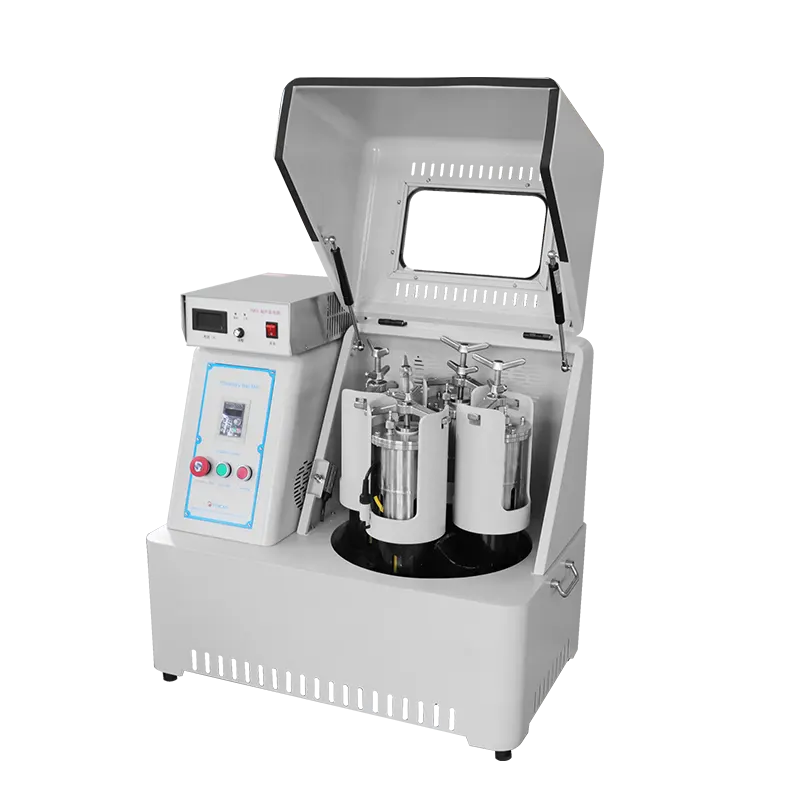
How Does It Work?
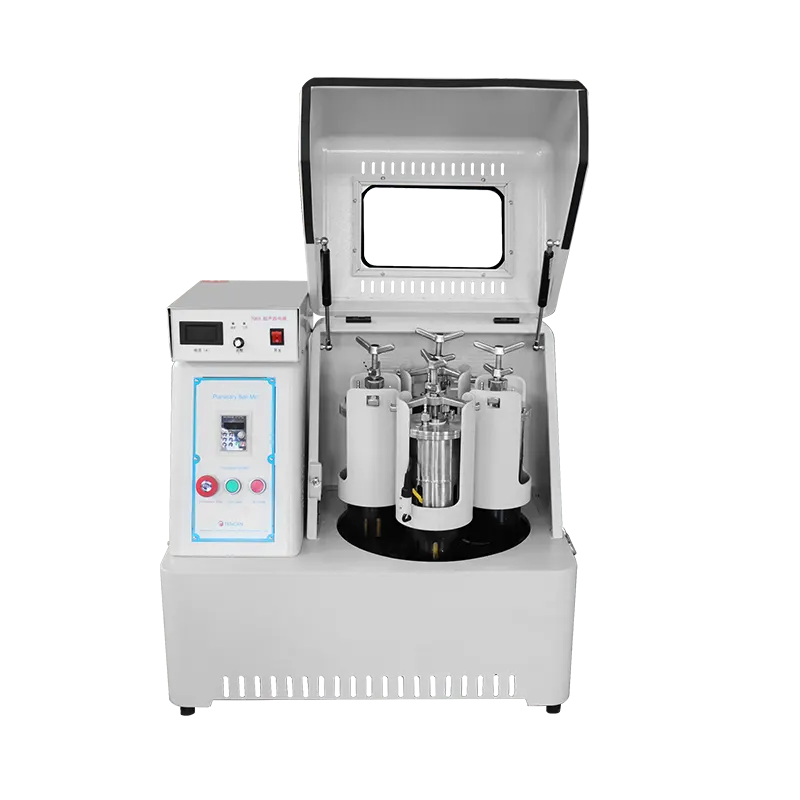
The ultrasonic planetary ball mill operates on the same principle as a standard planetary ball mill: the grinding jars rotate on their own axes while the main disk rotates in the opposite direction, creating a planetary motion that generates high centrifugal forces. Inside each jar, grinding balls collide with the material, producing intense mechanical energy. What sets this equipment apart is the addition of an ultrasonic transducer that introduces high-frequency vibrations (typically 20–40 kHz) into the grinding jar. The ultrasonic energy propagates through the liquid medium, creating cavitation bubbles that collapse and generate localized shock waves. These micro-jets help break down agglomerates, expose fresh surfaces, and promote uniform mixing. In many laboratory applications, this dual action can significantly reduce the time required to reach a target particle size and improve the consistency of the final product.
Synergy Between Mechanical and Ultrasonic Energy
The combination is not simply additive. The mechanical milling creates fresh surfaces and generates fine particles, while the ultrasonic field prevents those particles from sticking together. This synergy is particularly valuable when processing materials that are prone to cold welding, such as ductile metals, or when preparing nano-dispersions that need to remain stable after milling. By keeping the slurry well-dispersed during the entire process, the ultrasonic planetary ball mill also helps avoid the formation of dead zones inside the jar, ensuring that all particles receive equal treatment.
Key Advantages of Ultrasonic-Assisted Milling
Compared to conventional planetary ball mills, the ultrasonic version offers several practical benefits:
- Reduced Agglomeration: Ultrasonic vibration continuously breaks up soft agglomerates, allowing the mechanical impact to act on individual particles rather than clusters.
- Finer Particle Size: With better dispersion, the milling energy is used more efficiently, often enabling the production of particles with a smaller median size and narrower distribution.
- Shorter Milling Time: Because the process avoids re-agglomeration, the effective grinding rate is higher. In some cases, the same fineness can be achieved in half the time.
- Improved Slurry Stability: The ultrasonic energy helps de-agglomerate and homogenize the suspension, reducing the need for additional dispersing agents or post-milling steps.
- Versatility: The equipment can be used for dry milling in some configurations, but it is most effective in wet milling where the liquid medium transmits ultrasonic waves efficiently.
Applications in Research and Industry
The ultrasonic planetary ball mill is particularly suited for materials that are difficult to grind or that require precise control over particle size and dispersion. Common applications include:
- Nano Ceramics and Advanced Materials: Preparing nano-sized alumina, zirconia, silicon carbide, and other ceramic powders for sintering or composite fabrication.
- Battery Materials: Milling and dispersing active materials for lithium-ion batteries, such as cathode and anode powders, to improve electrochemical performance.
- Catalysts: Producing highly dispersed catalyst particles with high surface area for chemical reactions.
- Pharmaceuticals and Bioactive Compounds: Reducing particle size of active pharmaceutical ingredients to enhance bioavailability.
- Pigments and Dyes: Achieving consistent color strength and dispersion quality in inks and coatings.
- Mechanical Alloying: When alloying ductile metals, ultrasonic assistance helps prevent cold welding and promotes uniform alloy formation.
Selecting the Right Ultrasonic Planetary Ball Mill
Choosing the appropriate equipment for your laboratory depends on several factors. Here are the main considerations:
Grinding Jar Material and Volume
The jar material must be chemically compatible with your sample and should not introduce unacceptable contamination. Common options include stainless steel, zirconia, agate, tungsten carbide, and nylon. The volume of the jars should match your typical batch size. For most research applications, jar capacities from 50 mL to 1 L are common. Remember that the actual usable volume is about two-thirds of the total jar capacity, as you need space for the grinding balls and the moving slurry.
Ultrasonic Power and Frequency
Ultrasonic transducers are available with different power ratings (typically 100–500 W) and frequencies (20–40 kHz). Higher power provides stronger cavitation, but may generate more heat. Lower frequencies produce larger cavitation bubbles and stronger shock waves, making them suitable for coarse de-agglomeration. Higher frequencies offer more gentle dispersion for fragile particles. The optimal choice depends on your material hardness and the desired final particle size.
Temperature Control
Both mechanical milling and ultrasonic energy generate heat. If your material is temperature-sensitive, consider a model that allows cooling, such as a jacketed jar or a system that can be operated in intermittent mode (e.g., 10 minutes running, 5 minutes pause). Some advanced ultrasonic planetary ball mills come with integrated cooling systems that circulate water or refrigerant around the jars.
Operational Features
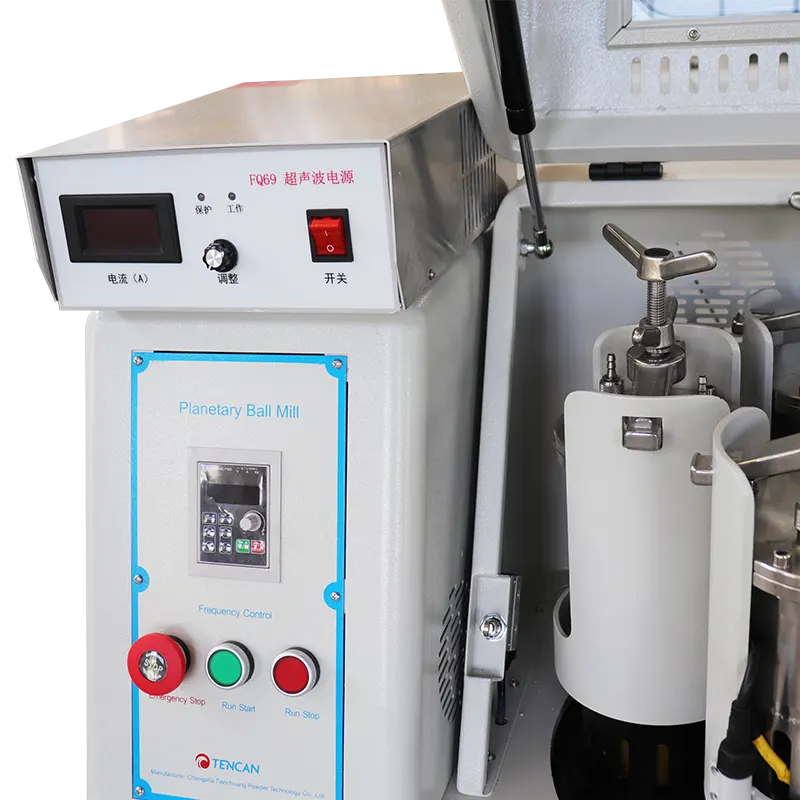
Look for features that improve usability and reproducibility: programmable speed control, forward/reverse rotation, adjustable ultrasonic duty cycle, and safety interlocks. A digital display or touch-screen interface can simplify parameter setting and data logging. For processing air-sensitive materials, you may need a vacuum-compatible jar or an inert gas purging option.
Practical Tips for Successful Ultrasonic Milling
To get the most out of your ultrasonic planetary ball mill, keep these tips in mind:
- Choose the right grinding media: The size and material of the grinding balls should match the target particle size. For coarse grinding, use larger balls (10–20 mm); for fine grinding, smaller balls (1–5 mm) provide more contact points.
- Optimize ball-to-powder ratio: A common starting point is a 5:1 to 10:1 weight ratio, but this can vary depending on the material density and hardness. Conduct small-scale trials to find the best ratio.
- Control slurry viscosity: If the slurry is too thick, ultrasonic energy cannot propagate effectively. Add enough liquid (usually water or a suitable solvent) to keep the mixture fluid.
- Use a dispersant if needed: For some materials, a small amount of surfactant or dispersant can further reduce agglomeration and improve final dispersion.
- Monitor temperature: If the jar becomes too hot, pause the milling and allow it to cool, or use a cooler to maintain a stable temperature.
Final Thoughts
The ultrasonic planetary ball mill represents a valuable evolution in laboratory powder processing. By integrating two complementary energy sources, it offers a practical solution for researchers who need to produce fine, well-dispersed powders efficiently. Whether you are working on nano-materials, battery components, or advanced ceramics, this equipment can help you achieve better results in less time. When selecting a system, consider your specific material requirements, the volume of samples, and the level of process control you need. A well-chosen ultrasonic planetary ball mill can become a reliable workhorse in your lab, supporting both routine grinding and challenging nano-scale applications.
For more detailed technical specifications and configuration options, you can explore the ultrasonic planetary ball mill product page, where you will find information on available jar materials, ultrasonic power ranges, and compatible accessories.