
What is a Vacuum Freeze-Drying Oven? A Low-Temperature Drying Equipment for Preserving Biological Activity
What is a Vacuum Freeze-Drying Oven? A Low-Temperature Drying Equipment for Preserving Biological Activity
From the core, a vacuum freeze-drying oven (also known as a lyophilizer) is a professional drying device that utilizes the principle of sublimation to remove moisture from frozen materials under a high vacuum environment. It is widely used by pharmaceutical, biotech, food, and research laboratories to transform heat-sensitive liquids or solids into stable, dry powders without compromising their chemical structure, biological activity, or rehydration properties. This technology is essential for preserving vaccines, enzymes, probiotics, coffee, and many other delicate products.
Core Function and Working Principle
The fundamental function of a vacuum freeze-drying oven is to convert a wet material from a frozen state into a dry, porous solid while bypassing the liquid phase. The entire process involves three key stages:
1. Pre-freezing
The material is first rapidly cooled to a temperature well below its eutectic point (typically -20°C to -80°C) to ensure all free water is converted into solid ice crystals. This step is critical for maintaining the material's original morphology and preventing damage from ice crystal growth.
2. Primary Drying (Sublimation)
Once frozen, the chamber is evacuated to a high vacuum (usually below 100 Pa). Under these conditions, the ice crystals directly transition from solid to vapor without melting. The shelves are gently heated to provide the latent heat needed for sublimation, while the water vapor is captured by a cold trap (condenser) that is maintained at an even lower temperature (e.g., -60°C). This step removes the majority (about 95%) of the water content.
3. Secondary Drying (Desorption)
After the visible ice has sublimed, the shelf temperature is further increased to eliminate bound water molecules that are adsorbed to the material's surface. The final product typically has a residual moisture content of 1-3%, which guarantees long-term stability and shelf life.
Key Components and Critical Technologies
A vacuum freeze-drying oven is an integrated system consisting of several essential sub-systems:
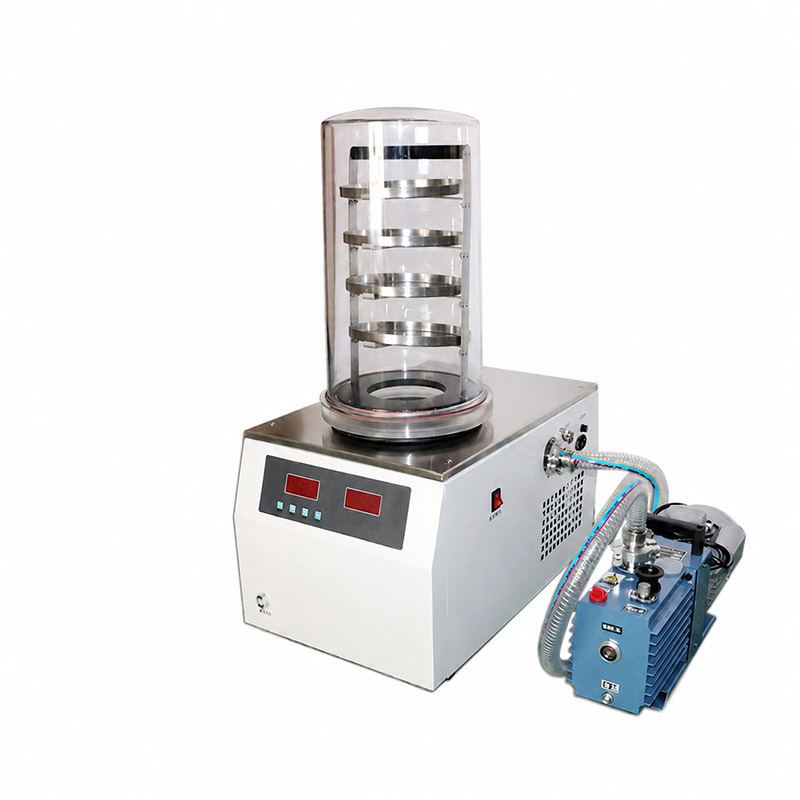
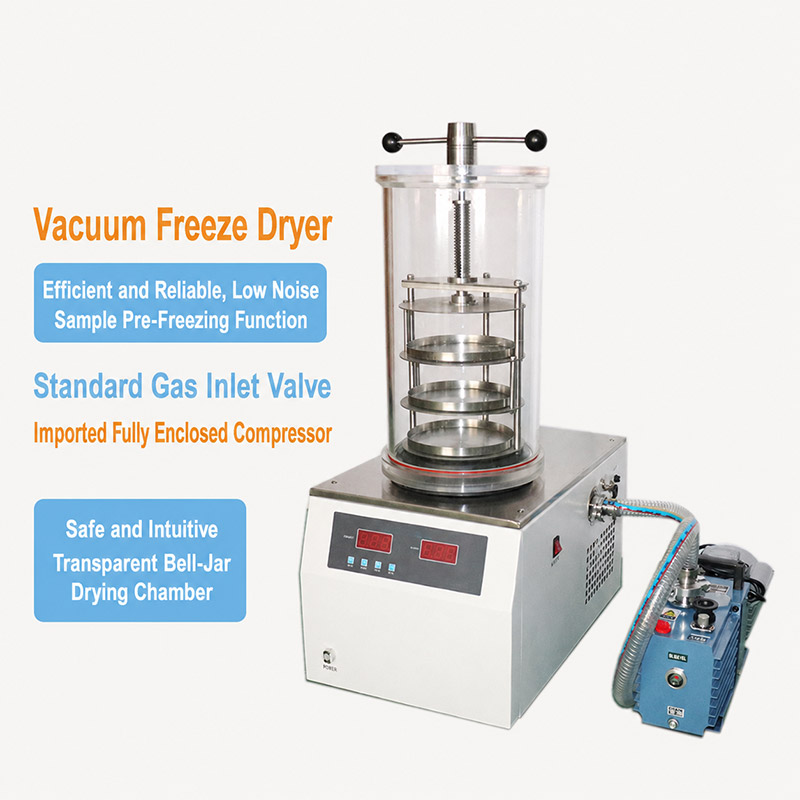
- Drying Chamber (Shelf System): A vacuum-tight chamber with temperature-controlled shelves that hold the product containers. The shelves are made of corrosion-resistant stainless steel and can be heated or cooled through a circulating heat transfer fluid.
- Condenser (Cold Trap): A low-temperature heat exchanger that traps water vapor from the chamber. Its temperature is typically 10-20°C lower than the shelf temperature to ensure efficient capture.
- Vacuum System: A vacuum pump (or pump set) that creates and maintains the required low pressure. The ultimate vacuum level directly affects the sublimation rate and product quality.
- Refrigeration System: Provides cooling for both the shelves during pre-freezing and the condenser. It usually employs a cascade refrigeration cycle or a single-stage compressor with special refrigerants.
- Control System: A programmable logic controller (PLC) with a touchscreen interface that monitors and regulates temperature, vacuum, and time. Advanced models allow users to store and execute multiple lyophilization recipes.
Key Performance Indicators and Selection Criteria
When selecting a vacuum freeze-drying oven, several technical parameters should be carefully evaluated:
- Condenser Temperature: A lower condenser temperature (e.g., -60°C to -80°C) ensures faster water vapor capture and better vacuum stability. For materials with low eutectic points, a -80°C condenser is recommended.
- Ultimate Vacuum: Most freeze-drying ovens can achieve 1-10 Pa. The tighter the vacuum, the more efficient the sublimation. For high-value biological products, a vacuum below 5 Pa is desirable.
- Freeze-Drying Area: The total shelf area (in square meters or square inches) determines the batch capacity. Laboratory units typically offer 0.1-0.5 m², while production units exceed 1 m².
- Temperature Control Accuracy: Precise control of shelf temperature (within ±0.5°C to ±1°C) is crucial for uniform drying and preventing product collapse.
- Ice Capacity: The maximum amount of water the condenser can trap before needing defrosting. Larger capacities allow longer continuous runs.
- Automation and Data Logging: Modern units come with programmable recipes, real-time data recording, and remote monitoring features, which are essential for regulatory compliance (e.g., FDA 21 CFR Part 11).
Application Fields and Selection Advice
Vacuum freeze-drying ovens are widely used in:
- Pharmaceutical industry: For lyophilizing injectable drugs, vaccines, antibiotics, and diagnostic reagents.
- Biotechnology: Preservation of enzymes, proteins, bacteria, and cell cultures.
- Food industry: Freeze-drying of coffee, fruits, vegetables, instant meals, and nutritional supplements.
- Research laboratories: Sample preparation, material science, and botanical extraction studies.
For users with small sample volumes or occasional use, a benchtop model with a simple control system is sufficient. For high-throughput production or critical pharmaceutical applications, a floor-standing model with full automation, validation support, and clean-in-place (CIP) features is recommended. Always verify the compatibility of the materials of construction (e.g., stainless steel, gaskets) with your product's chemical requirements.
For more detailed specifications and product options, please visit the Vacuum Freeze-Drying Oven product page.