
What is a Laboratory Sand Grinder? A Wet Grinding Mill Used for Nano-Grinding and Dispersion in Research Labs
What is a Laboratory Sand Grinder?
At its core, a laboratory sand grinder is a specialized wet grinding mill used by research laboratories, pilot plants, and small-scale production facilities to disperse and grind solid particles in a liquid medium down to the micron or even nanometer scale. Also known as a laboratory bead mill or nano mill, it is the go-to equipment for formulating high-quality suspensions, slurries, and pastes in industries such as paints, inks, coatings, agrochemicals, pharmaceuticals, and advanced ceramics.
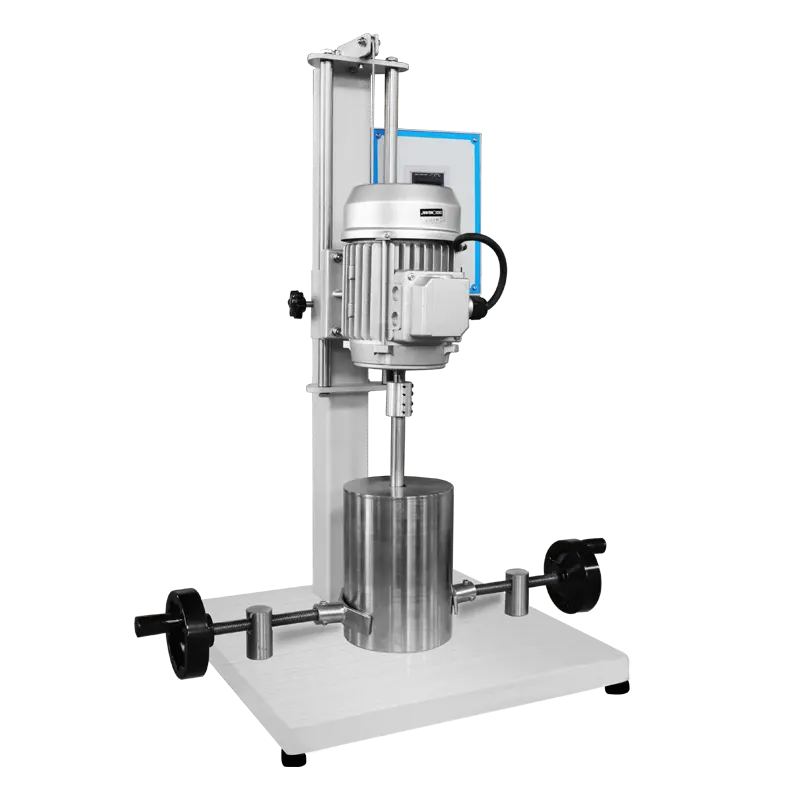
Core Function and Working Principle
The laboratory sand grinder transforms coarse pre-mixed slurries into finely dispersed, stable suspensions. Its working principle relies on the high-energy impact and shear forces generated between grinding media (typically zirconia beads or ceramic balls) and the product particles.
Inside a stationary or rotating grinding chamber, an agitator shaft equipped with discs, pins, or turbines rotates at high speed (up to several thousand rpm). This motion accelerates the grinding media, which collide with each other and with the chamber walls, creating intense shear and impact zones. The feed slurry, introduced via a pump, passes through the chamber in a continuous or recirculating loop. As the particles travel through the active grinding zone, they are repeatedly trapped between the beads, resulting in progressive size reduction and de-agglomeration.
Key process parameters include agitator speed, bead size (typically 0.1–1.0 mm), bead filling ratio, residence time, and temperature control. The final particle size distribution can be tuned by adjusting these variables, with the most advanced models achieving D50 values below 100 nm.
Main Types and Key Components
By Chamber Orientation
Laboratory sand grinders are available in horizontal and vertical configurations. Horizontal models are more common for nano-grinding because they offer better bead distribution and lower risk of sedimentation. Vertical models are simpler and easier to clean but may have limitations in high-viscosity applications.
By Agitator Design
Three main agitator designs dominate the market:
- Disc-type (pin or slotted): Provides high energy density and is suitable for low to medium viscosity slurries.
- Pin-type (rod or bar pin): Offers higher shear forces and is ideal for high-viscosity materials and nano-grinding.
- Turbine-type: Generates strong axial flow, enhancing mixing and reducing dead zones.
Key Components
Critical components of a laboratory sand grinder include:
- Grinding chamber: Made from wear-resistant materials like zirconia, silicon carbide, or hardened steel.
- Agitator shaft: Often coated with ceramic or polyurethane to prevent metal contamination.
- Separation system: A dynamic gap separator or screen ensures beads remain inside the chamber while the product exits.
- Cooling jacket: Essential for removing heat generated during high-energy grinding, preventing thermal degradation of heat-sensitive materials.
- Feed pump: Typically a diaphragm, peristaltic, or screw pump for precise flow control.
Key Performance Indicators and Selection Criteria
When selecting a laboratory sand grinder, consider the following parameters:
- Grinding fineness: The minimum achievable particle size (e.g., D50 < 100 nm) and the ability to produce a narrow particle size distribution.
- Throughput capacity: Typically 0.5–30 L/h for lab models, depending on chamber volume (0.1–5 L).
- Energy efficiency: Higher power density (kW/L) can reduce grinding time but increases heat generation.
- Cooling efficiency: Adequate cooling is critical for maintaining product quality, especially for temperature-sensitive formulations.
- Material of construction: Must be compatible with the product to avoid contamination (e.g., ceramic or stainless steel wetted parts).
- Ease of cleaning: Quick-disassembly design and smooth surfaces minimize cross-contamination between batches.
- Automation and control: PLC-based systems with touchscreen interfaces, variable speed drives, and integrated temperature/pressure monitoring enhance reproducibility.
Application Areas and Selection Advice
Laboratory sand grinders are indispensable in:
- Paints and coatings: For dispersing pigments, fillers, and additives to achieve high gloss and color strength.
- Printing inks: To produce fine, stable dispersions for offset, gravure, and flexographic inks.
- Agrochemicals: For milling pesticide suspensions (SC, OD) to ensure uniform application and bioavailability.
- Battery materials: For dispersing electrode slurries (e.g., lithium iron phosphate, graphite) in the R&D phase.
- Ceramics and advanced materials: For wet grinding of oxide powders, nano-pigments, and functional coatings.
- Pharmaceuticals and cosmetics: For nano-suspensions, liposomes, and sunscreens.
For most laboratory applications, a horizontal pin-type mill with a 0.3–1.0 L chamber and zirconia ceramic wetted parts offers the best balance of versatility and performance. If throughput higher than 5 L/h is needed, consider a larger model (e.g., 1.5–5 L) or a production-scale version. Always request a sample test from the manufacturer to validate the process parameters before purchase.
References
For more details, visit the product page: Laboratory Sand Grinder. Related products include Three Roll Mill and Basket Mill.