
Precision Air Blower Dryer: Lab Sample Drying
Moisture is one of the few process variables in a laboratory that can be present without being visible. A powder that pours freely can still carry adsorbed water on the surface of every particle, and that water follows the sample into every downstream step: the weighed batch, the milling jar, the slurry tank, the press die, and the sintering furnace. Drying is therefore not a preliminary housekeeping task. It is the step that decides whether the rest of the workflow behaves the same way twice.
Drying is also easy to do badly. A static oven crowded with sample dishes can leave the inner layers of a powder bed wet while the surface looks dry, and a warm sample taken out too early can re-adsorb moisture from the air as it cools. In a covered crucible or a sealed jar, that trapped moisture shows up much later, as caked powder, a cracked green body, or an analysis result that cannot be repeated.
Forced-air drying avoids most of these problems by using moving air as a carrier. Instead of waiting for vapor to diffuse out of a stagnant chamber, a blower keeps pushing warmed air across the sample, so the humid layer near the material is continuously replaced with drier air and the evaporation rate stays high. A precision air blower dryer such as the unit offered by Changsha Tianchuang Powder Technology Co., Ltd (TENCAN) in its sintering series is built on this principle: air is moved through the working chamber, temperature is controlled, and moisture leaves with the exhaust stream instead of condensing on the walls or back onto the sample.
What follows is a practical look at how these dryers behave, which parameters actually control drying speed and quality, how different materials respond, and what to confirm before specifying a unit for a laboratory bench, a pilot line, or a production support area.
Why Residual Moisture Causes Problems Before Milling and Sintering
Water in a sample is not just extra weight. Surface water and adsorbed layers change the way particles interact with each other and with the walls of the equipment they touch. In a milling jar, a small amount of moisture creates liquid bridges between particles, and those bridges turn a free-flowing powder into agglomerates that resist comminution. The result is a wider particle size distribution, more energy consumed for the same target size, and a product that behaves differently from batch to batch even when the mill settings never changed.
The consequences extend well beyond milling. Moisture affects weighing accuracy when a sample is charged by mass, raises the internal pressure of sealed grinding jars as the contents warm up, promotes hydrolysis and oxidation in reactive powders, and accelerates corrosion of grinding media and jar linings. In ceramic and metal powder processing, residual water and volatiles are a direct source of defects: blisters, pores, delamination and dimensional distortion often trace back to a green body that still contained moisture when it entered the furnace.
Typical downstream effects of insufficient drying include:
- Weighing and stoichiometry errors when moisture content varies between batches or between the top and bottom of a container.
- Agglomeration and caking in ball mills, jet mills and sieve stacks, leading to screen blinding and inconsistent fractions.
- Pressure and leakage problems in sealed milling jars and glove box transfers.
- Sintering defects such as cracks, blisters and uneven shrinkage when volatiles escape too late.
- Analytical bias in sieve analysis, X-ray diffraction, thermal analysis and surface area measurement.
- Chemical side reactions, including hydrolysis of sensitive compounds and oxidation of fine metal powders.
Because these effects appear at different points in the workflow, the drying step is often blamed last. A simple gravimetric check, weighing a sample before and after a defined drying cycle until the mass stops changing, is usually enough to show whether moisture is the real cause of an unstable process.
How a Precision Air Blower Dryer Moves Moisture Out of a Sample
All thermal drying works on the same physical idea: energy is supplied to the water in the sample, and the resulting vapor must be removed from the surroundings. The second half of that sentence is where designs differ, and it is where a blower-based dryer separates itself from a simple heated cabinet.
Convection and the Driving Force for Evaporation
When air passes over a wet surface, water evaporates into the air stream until the air close to the surface approaches saturation. If that air is not replaced, evaporation slows to whatever rate diffusion through the humid boundary layer allows. A blower solves this by continuously exchanging the air in the chamber, keeping the local vapor concentration low and the driving force for evaporation high. In practice, the drying rate is governed less by how hot the chamber is than by how effectively humid air is removed from the sample surface.
This is why two ovens set to the same temperature can produce very different results. The unit with better air exchange dries the same powder in a fraction of the time, and it dries the sample more evenly, because the top layer of a powder bed is no longer the only place where moisture can escape.
Air Exchange Versus Static Heating
A static oven transfers heat mainly by radiation and natural convection. Air near the heating elements rises, circulates slowly, and tends to stratify, so samples at different shelf heights may see noticeably different conditions. Humid air also accumulates in the chamber, which means that the last part of the drying cycle is the slowest. In a forced-air design, the blower flattens those gradients and sweeps the moisture out as it forms.
The difference matters most for dense loads, deep powder beds, and samples with low permeability, where vapor must travel a long path to reach the surface. It also matters for glassware and porous ceramic parts, where water trapped in narrow channels is slow to leave without an air stream to carry it away.
What "Precision" Adds to a Laboratory Dryer
In a laboratory context, precision usually refers to how tightly the unit holds its set point, how uniformly it distributes temperature across the chamber, and how reproducible a drying cycle is from one run to the next. Tight control protects heat-sensitive materials from overshoot, keeps a repeatable reference temperature for comparative tests, and makes it possible to document a drying protocol that another operator can follow. Because drying is often a preparatory step that nobody records in detail, a dryer with stable, readable control is what turns that step into a documented parameter rather than an educated guess.
Exact temperature ranges, airflow rates, chamber volumes and control resolution vary by model and configuration, and the specification sheet for the specific unit should always be confirmed before a purchase decision or a process validation run.
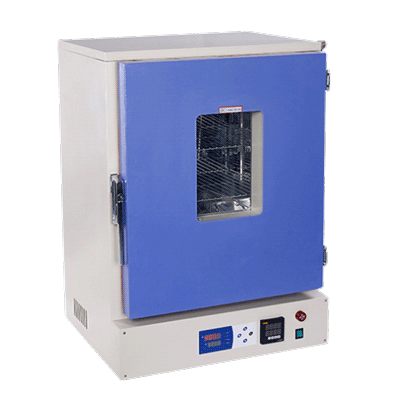
The precision air blower dryer from TENCAN uses a blower-driven air stream to remove moisture from laboratory samples.
Inside the Equipment: Blower, Chamber and Control
Understanding the main building blocks of an air blower dryer makes it much easier to judge whether a particular unit fits a given sample type. The three areas that deserve the closest attention are the air circulation system, the chamber and its loading arrangement, and the control and safety package.
Air Circulation and the Blower Assembly
The blower is the heart of the design. It determines how much air passes through the chamber, how quickly humid air is discharged, and how uniform the velocity field is around the samples. In most laboratory blower dryers, air is drawn in, passed over a heating element or heat exchanger, directed through the working space, and then exhausted or partly recirculated. Recirculation saves energy but must be balanced against the need to remove moisture, which is why the exhaust path and fresh-air intake are as important as the heater itself.
For work with fine powders, the intake path also matters for a different reason: a poorly protected intake can pull dust into the blower and the heater area, which affects both cleanliness and long-term reliability. Filtration and an accessible air path are practical features to look for when the dryer will be used with dusty materials.
Chamber, Shelves and Sample Placement
Chamber geometry decides how samples should be arranged. Shelves, trays, perforated plates and racks all change the way air reaches the material. A tray loaded edge to edge with powder blocks the airflow path and creates a slow-drying zone in the middle; the same mass of powder spread in a thinner layer and spaced away from the walls dries much faster. Perforated supports and open mesh trays help because air can move above and below the sample.
Loading discipline is part of the equipment's performance, not a separate issue. Leaving a clear gap at the rear and sides of the chamber, keeping shelves at the spacing recommended for the unit, and avoiding stacked containers all improve the uniformity of the drying cycle without changing a single set point.
Controls, Sensors and Operating Safety
Control hardware determines how much of the drying process can be verified and documented. A readable temperature display, an adjustable set point, and ideally an independent over-temperature cutout are basic expectations for laboratory work. Timers help standardize cycles, and any alarm or shutoff function should be tested before the unit is used with valuable samples.
Ventilation and exhaust routing should be planned before installation. Water vapor is harmless in most cases, but samples that carry solvents or volatile organics require an assessment of flammability and toxicity, and the dryer should only be used for those materials if the manufacturer confirms that the configuration is suitable. When in doubt, the correct answer is to ask rather than to test the limits of the equipment.
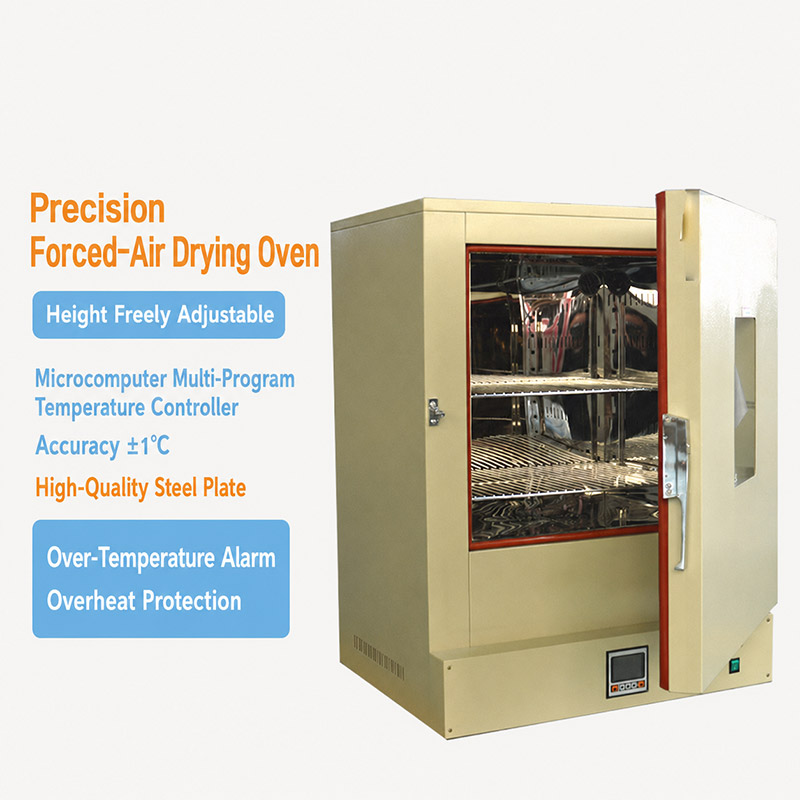
Chamber layout and loading practice have as much influence on drying uniformity as the temperature set point.
Matching the Dryer to the Material Being Dried
There is no single drying recipe that suits every sample, and a protocol that works well for coarse mineral powder can damage a heat-sensitive organic material. The deciding factors are usually water content, particle size, bed depth, thermal sensitivity and the way moisture is bound inside the material.
Ceramic, Mineral and Metal Oxide Powders
Coarse ceramic and mineral powders generally dry quickly because water moves freely through the pore network and reaches the surface without much resistance. Alumina, zirconia, quartz, feldspar and similar oxides can usually be dried at moderate temperatures with good airflow, and the main risk is not thermal damage but incomplete drying in thick beds. Spreading the powder in a thin layer on a perforated tray is often more effective than raising the temperature, because it shortens the path that vapor must travel before it enters the air stream.
Very fine oxide powders behave differently. As particle size decreases, surface area increases sharply and more water is held as an adsorbed film rather than as free liquid, so the final portion of the drying curve is slow. In these cases a longer cycle at a moderate temperature is safer than a short cycle at a high temperature, which can bake a crust on the surface and trap moisture underneath.
Battery Materials, Catalysts and Fine Chemicals
Materials used in battery research, catalysis and fine chemical synthesis often combine small particle size with sensitivity to heat, oxygen or humidity. Drying conditions interact directly with surface chemistry: an active material dried too aggressively can lose surface hydroxyl groups or change its crystalline state, while one dried too gently may retain enough water to affect slurry rheology and electrode coating quality.
For these samples, the drying temperature should be set below the level at which the material changes, and the cycle should be validated gravimetrically. It is also worth deciding in advance whether the sample can be exposed to the ambient atmosphere after drying. Many fine powders re-adsorb moisture within minutes if they are left in an open dish, so transfer to a desiccator or a sealed container while still warm is a practical part of the protocol.
Glassware, Crucibles and Heat-Sensitive Items
Drying is not limited to powders. Crucibles, boats, milling jars, grinding media and glassware all need to be moisture-free before use, particularly when a small residual amount of water would change the chemistry of the batch. Moving air reaches into narrow necks and cavities much more effectively than a static oven, which is one reason blower dryers are common in laboratories that prepare containers for sensitive work.
Plastic components, polymers and some composite samples require more care. The temperature must stay below any softening point, and the airflow should not be so strong that light parts are displaced. For these items, a moderate temperature with a longer cycle and good air exchange is the safer combination.
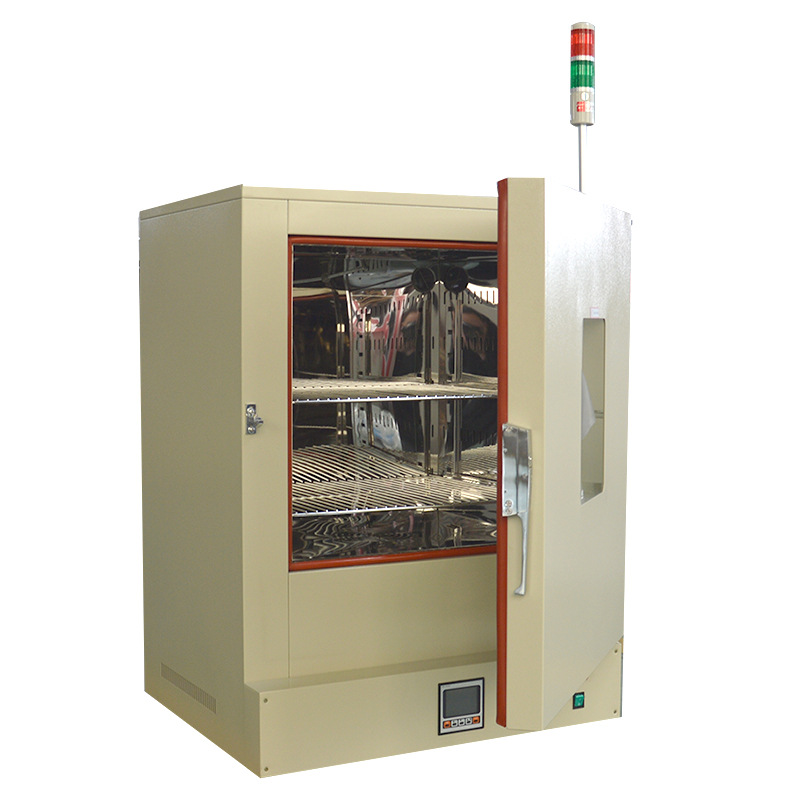
Blower dryers handle glassware and crucibles as well as powders, because moving air reaches into cavities and narrow openings.
Process Parameters That Decide Drying Time and Quality
When a drying cycle does not behave as expected, the cause is usually one of a small number of variables. The table below summarizes how each one affects the process and what can be adjusted in practice.
| Parameter | Effect on drying | Practical adjustment |
|---|---|---|
| Air temperature | Raises the vapor pressure of water and speeds evaporation, but has diminishing returns once the surface is dry | Increase in small steps; verify the material tolerates the temperature before extending the cycle |
| Airflow rate and exchange rate | Controls removal of humid air; often the dominant factor in the falling-rate stage | Improve airflow paths, avoid blocked vents, reduce load density |
| Inlet air humidity | Humid ambient air slows the final stage of drying and can cause re-adsorption during cooling | Dry the sample in the morning or in a conditioned space; cool in a closed or desiccated environment |
| Bed depth and surface area | Determines the distance vapor must travel; deep beds dry unevenly | Spread material in thin, even layers on perforated trays |
| Particle size and porosity | Fine, dense or hygroscopic materials hold more water and release it more slowly | Extend the cycle rather than raising temperature sharply |
| Loading pattern | Overloading or blocking the airflow path creates cold, humid pockets | Keep clearances at the rear and sides; avoid stacking containers |
| Cooling stage | Warm samples can re-adsorb moisture as they cool | Transfer to a desiccator or sealed container while warm |
Temperature deserves particular caution. Raising the set point shortens the constant-rate stage, when free water is evaporating from the surface, but it does not solve a moisture-retention problem caused by a deep bed or poor air exchange. In many cases the better move is to reduce the load per tray, increase the spacing between trays, or extend the cycle, all of which cost nothing but a little planning.
Contamination Control and Sample Handling
Drying concentrates whatever was dissolved or suspended in the water. As liquid evaporates, dissolved salts migrate toward the surface of the sample and can form a deposit that changes local composition. For trace analysis or for mixtures where homogeneity matters, this is a real risk and not a theoretical one, and it is one reason why drying parameters should be fixed and recorded rather than adjusted casually.
Cross-contamination is a second concern. Air that passes over one sample continues on to the next, so fine dust, volatile residues and airborne particles can be carried from a dirty load to a clean one. Practical measures include drying clean items first, using covered trays or a separate shelf for dusty materials where the airflow allows it, and cleaning the chamber and shelves between loads. Where contamination thresholds are strict, the sample should be dried in its own covered container with adequate air exchange, or the drying step should be moved to a dedicated unit.
Sample loss is a third issue that is easy to overlook. Fine powders can be lifted by an air stream, particularly if the tray is shallow or the powder is light. Choosing a suitable container depth, avoiding direct exposure of loose fine powder to the highest-velocity air path, and keeping the load below the level that would disturb the material all help protect both the sample and the equipment.
Selection Checklist for a Laboratory Blower Dryer
Specifying a dryer is easier when the questions are asked in the right order. The chamber has to accommodate the largest item, the temperature range has to cover the most sensitive material, and the airflow has to be able to handle the heaviest load without losing uniformity. Capacity decisions made only from a catalog figure, without considering tray layout and airflow clearance, usually lead to an oversized unit that is run half empty or an undersized one that is always overloaded.
- Largest and smallest samples the unit must handle, including crucibles, jars and glassware as well as powder trays.
- Temperature range and control stability, checked against the most heat-sensitive material in the workflow.
- Airflow characteristics and chamber uniformity, including how the air enters and leaves the working space.
- Exhaust and ventilation requirements, especially if solvent-bearing samples may ever be processed.
- Materials of construction and their compatibility with the powders and vapors involved.
- Filtration and cleanliness, judged by how easily the air path and chamber can be cleaned.
- Controls, timers and safety interlocks, including any over-temperature protection.
- Documentation, so that a validated cycle can be repeated by another operator without reinterpretation.
For laboratories that also crush, mill or classify powders, it is worth evaluating the dryer together with the rest of the sample preparation chain, because drying quality directly affects milling efficiency and sieving reproducibility. The precision air blower dryer for laboratory sample drying is positioned as one step in that chain, and its chamber size, temperature range and airflow configuration should be confirmed against the specific samples and batch sizes in use.
Common Drying Problems and How to Correct Them
Most drying problems fall into a handful of recognizable patterns. Diagnosing them gravimetrically, by weighing the sample at intervals during a test run, is usually faster than changing several settings at once and guessing which one helped.
| Symptom | Likely cause | What to adjust |
|---|---|---|
| Surface looks dry, mass keeps dropping | Deep bed or low permeability trapping moisture in the interior | Spread the sample thinner, extend the cycle, add a mid-cycle stir for stable powders |
| Sample dry on removal, wet again later | Re-adsorption during cooling or storage in open air | Transfer warm to a desiccator or sealed container |
| Crust or hard shell on powder | Temperature too high, drying the surface faster than vapor can escape | Lower the temperature, lengthen the cycle |
| Uneven results across the chamber | Blocked airflow, overloading, or mixed sample depths | Respace trays, reduce load, use identical containers and depths |
| Powder carried out of the tray | Air velocity too high for a light or fine material | Use deeper covered containers and reduce direct exposure to the air stream |
| Long drying times that never improve | Humid inlet air or inadequate air exchange | Check exhaust path and ventilation, dry in a conditioned room |
Frequently Asked Questions
How long should a powder sample be dried in an air blower dryer?
There is no universal time. Drying depends on the initial moisture content, the material's porosity and hygroscopicity, the bed depth, the airflow, and the temperature that the sample can tolerate. The practical way to set a cycle is to run a gravimetric test: dry in fixed intervals, weigh the sample each time, and continue until the mass stops changing. That value becomes the standard cycle for that material, with a small safety margin.
Can a blower dryer handle solvent-wet samples?
Only when the unit and its installation are rated and ventilated for that application. Solvent vapors introduce flammability and health considerations that water vapor does not, and the exhaust system must be designed accordingly. The safe course is to confirm suitability with the manufacturer before any solvent-bearing sample is placed in the chamber.
Is a forced-air dryer better than a vacuum oven?
They solve different problems. A vacuum oven is often preferred for oxidation-sensitive or heat-sensitive materials, since drying can proceed at a lower temperature. A forced-air blower dryer is generally faster and more convenient for bulk water removal, for glassware and crucibles, and for the many powders that simply need moisture gone before the next step. Many laboratories keep both and route each sample to the appropriate unit.
Turning Drying into a Controlled Step
Drying earns its place in the workflow when it is treated like any other process parameter. Fix the temperature, the load per tray, the tray spacing and the cycle time; verify the endpoint by mass rather than by appearance; and record the protocol so the next operator reproduces it without discussion. Once those elements are stable, moisture stops being an invisible variable and becomes a number that can be checked.
For laboratories preparing powders for milling, pressing, sintering or analysis, the TENCAN precision air blower dryer reflects this approach by combining blower-driven air movement with controlled heating, so that moisture is carried away rather than redistributed. Because drying behavior depends strongly on material properties and process conditions, a short validation run on the actual sample, using agreed acceptance criteria, remains the most reliable way to confirm that a chosen configuration suits the intended work.