
What is a Micro Planetary Ball Mill? A Compact Grinding Device for Small-Batch Sample Preparation in Glove Boxes
What is a Micro Planetary Ball Mill?
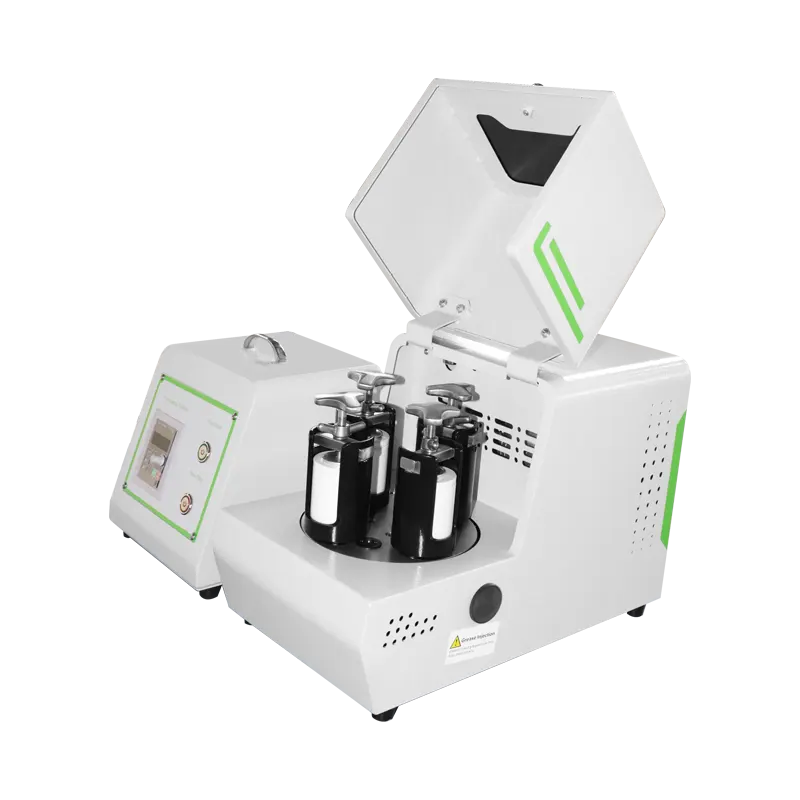
At its core, a micro planetary ball mill is a specialized laboratory grinding device used to pulverize, mix, and homogenize small quantities of solid materials — typically from a few grams to tens of grams per batch. It is especially designed for applications where sample volume is limited, such as in research laboratories, universities, and R&D centers exploring new materials, precious metals, or air-sensitive compounds. Often configured for use inside a glove box, this mill enables the safe processing of materials that must be protected from oxygen or moisture.
Core Function and Working Principle
How It Transforms Coarse Particles into Fine Powders
The micro planetary ball mill converts solid particles from an initial state of coarse chunks or granules (typically 0.5–3 mm feed size) into a final state of fine or ultrafine powder, with achievable fineness down to less than 0.1 μm. The process relies on a unique planetary motion mechanism: the main disk (sun wheel) rotates around a central axis, while the milling jars (planetary jars) mounted on the disk rotate around their own axes in the opposite direction. This creates a complex motion path where grinding balls inside the jars experience high centrifugal forces, resulting in repeated high-energy impacts, shearing, and friction between balls, jar walls, and the sample.
Key Mechanisms: Impact, Shear, and Friction
Three mechanical forces work together during milling: impact from balls colliding with the material, shear from ball-to-ball and ball-to-wall sliding, and friction from the rolling of balls. These forces enable the mill to handle a wide variety of materials — including hard, brittle, fibrous, and medium-hard samples — in both dry and wet grinding modes. For heat-sensitive or easily oxidized materials, optional accessories such as low-temperature milling attachments or vacuum/argon atmosphere milling jars can be used to preserve sample integrity.
Key Components and Technical Features
Although the micro planetary ball mill is compact, it incorporates several critical components that determine its performance:
- Milling Jars and Balls: Available in materials like agate, zirconia, stainless steel, tungsten carbide, and nylon, the jar and ball material must be chosen to avoid contamination and to match the sample's hardness and reactivity. Typical jar capacities range from 50 ml to 250 ml, with 0.2 L models being common for micro versions.
- Drive System: A precise motor and planetary gear train maintain a fixed transmission ratio (typically 1:2 between sun wheel and jar rotation). This ensures consistent and reproducible grinding results.
- Control Interface: Modern units feature a digital touch screen (e.g., 7-inch color LCD) that allows programming of speed (50–450 rpm for the main disk, corresponding to 100–900 rpm for the jars), run time (up to 999 hours), interval pauses (up to 9999 minutes), and cycle patterns (continuous, interval, or alternating direction).
- Safety and Convenience: Features like automatic locking, imbalance sensors, power-off memory, and silent operation (low noise) are common in quality models.
Key Performance Indicators and Selection Guide
When selecting a micro planetary ball mill, consider the following criteria:
Processing Capacity and Sample Volume
Micro models typically handle 0.2 L to 1 L per batch. If you need to process multiple samples simultaneously, look for models with two or four working stations. For glove box integration, ensure the mill's footprint fits inside the glove box chamber.
Fineness and Particle Size Control
The ability to achieve submicron or even nanometer particles depends on the maximum rotational speed, ball-to-sample weight ratio, grinding duration, and material properties. Models with adjustable speed and programmable operation allow fine-tuning for consistent results.
Material Compatibility and Contamination Prevention
Choose jar and ball materials that are chemically inert and harder than the sample. For trace analysis, avoid metal contamination by using agate or zirconia components. Sealing integrity of jars is critical when processing toxic or air-sensitive substances.
Automation and Reproducibility
Touch-screen controlled units with recipe storage enable easy repetition of optimized protocols, which is essential for method development and quality control. Remote control and data logging features add convenience for unattended operation.
Applications and Usage Recommendations
Micro planetary ball mills are widely used in fields such as geology, mineral processing, metallurgy, electronics, ceramics, chemistry, pharmaceuticals, and environmental testing. Typical applications include: soil and heavy metal analysis, battery material synthesis (e.g., lithium-ion cathode/anode powders), pharmaceutical formulation development, and nano-material preparation.
For users handling limited quantities of expensive or hazardous materials, a micro planetary ball mill is an ideal investment. Researchers who work with air-sensitive samples (e.g., lithium metal, organic perovskites) should prioritize models designed for glove box integration. For general-purpose lab grinding, a standard model with multiple jar materials offers flexibility. Always verify the maximum feed size, recommended grinding media, and available safety features against your specific needs.
Reference
Product Page: Micro Planetary Ball Mill (Glove Box Special Edition)