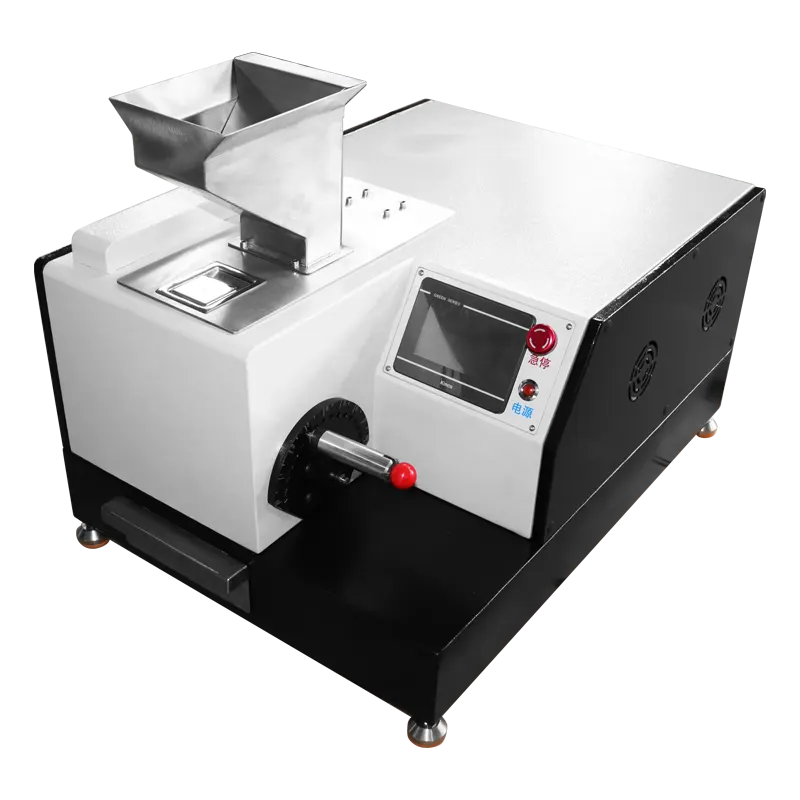
What is a Lab Jaw Crusher? A Crushing Equipment for Coarse Crushing of Hard Materials
What is a Lab Jaw Crusher?
At its core, a lab jaw crusher is a specialized crushing equipment used in laboratories and small-scale production lines to reduce large, hard materials into smaller, manageable particles. It is commonly employed in fields such as mining, geology, metallurgy, ceramics, and materials research for coarse crushing of ores, rocks, ceramics, and other brittle solids. The device operates by applying compressive force between a fixed jaw plate and a movable jaw plate, mimicking the biting action of animal jaws. This process prepares samples for subsequent fine grinding, sieving, or analysis.
Core Function and Working Principle
The lab jaw crusher transforms bulk materials from a coarse lump state (e.g., up to 60 mm or more) into a granular form (typically 2–15 mm) through a cyclic crushing action. The crushing chamber is a wedge-shaped cavity formed by the fixed jaw and the moving jaw. When the eccentric shaft rotates, driven by an electric motor, the movable jaw moves toward the fixed jaw, compressing, bending, and splitting the material. During the return stroke, the movable jaw moves away, allowing the crushed material to discharge through the adjustable discharge opening at the bottom.
Key parameters affecting the final product size include the gap between the jaw plates (adjustable via wedge or shim mechanisms), the rotational speed of the eccentric shaft, and the hardness of the material. The crushing ratio can reach up to 3–6 for coarse crushing, and the output particle size can be controlled within a range of about 2–30 mm depending on the model. Because the process is purely mechanical and does not involve grinding media, it avoids sample contamination when using appropriate jaw plate materials.
Key Components and Critical Technologies
Modern lab jaw crushers consist of several essential parts:
- Frame: Usually made of cast steel or welded steel with reinforcing ribs, providing rigidity and stability.
- Eccentric Shaft: Drives the movable jaw in a reciprocating motion; precision machining ensures smooth operation.
- Jaw Plates (Fixed and Movable): The core wear parts, typically made of high-manganese steel, wear-resistant alloy, stainless steel, or ceramic (e.g., zirconia). The choice of material directly affects contamination risk and durability. For samples sensitive to metal contamination, ceramic or stainless steel jaw plates are recommended.
- Toggle Plate (Pitman): Transmits force and also acts as a safety fuse; if uncrushable material enters the cavity, the toggle plate breaks first to protect the machine.
- Discharge Opening Adjustment Device: Common types include wedge adjustment, shim adjustment, and hydraulic adjustment. The wedge type is quick and convenient for laboratory use.
- Safety Interlock: Many lab jaw crushers have a safety switch that automatically cuts power when the door is opened, ensuring operator protection.
Key Performance Indicators and Selection Criteria
When selecting a lab jaw crusher, users should evaluate the following factors:
- Feed Size and Discharge Size: The maximum feed opening determines the largest lump the machine can accept. The discharge adjustment range must match the requirements of downstream processes (e.g., planetary ball mill feed size, typically <5 mm).
- Processing Capacity: Laboratory models usually handle 50–300 kg/h. Choose a capacity that matches your sample throughput needs without over-sizing.
- Jaw Plate Material: For general-purpose use, high-manganese steel is cost-effective. For trace analysis or high-purity materials, opt for stainless steel, tungsten carbide, or ceramic (e.g., zirconia) to avoid metal contamination.
- Crushing Ratio and Particle Uniformity: A higher crushing ratio reduces the need for multiple passes. Uniform particle size distribution minimizes variability in later grinding.
- Ease of Cleaning: Quick-release mechanisms for the crushing chamber and easily removable jaw plates reduce cross-contamination between batches.
- Maintenance and Spare Parts Availability: Check the availability of replacement jaw plates, toggle plates, and bearings. Standardized parts from reputable suppliers ensure long-term support.
Applications and Selection Advice
Lab jaw crushers are widely used in:
- Geological and Mining Research: Crushing rock cores and ore samples for mineral analysis.
- Ceramic and Glass Industry: Breaking fired rejects, raw materials, and glass cullet.
- Construction Materials: Crushing concrete, cement clinker, and aggregates for quality control.
- Environmental Testing: Preparing soil, sludge, and solid waste samples for heavy metal or organic analysis.
- Pharmaceutical and Chemical: Crushing hard tablets, catalysts, and chemical intermediates.
For first-time buyers, we recommend starting with a mid-range model (e.g., feed opening ~100×60 mm, discharge adjustable from 2–15 mm) with high-manganese steel jaw plates. If your samples are highly abrasive or require high purity, invest in ceramic or stainless steel jaw plates. Always check the compatibility with your existing lab jaw crusher accessories, such as dust collection ports and safety interlocks. For more information on related crushing equipment, you can also explore the Double Roll Crusher or Jaw Crusher pages.