
What is an Inner Lined Roll Ball Mill? A Versatile Grinding Equipment for Contamination-Free Wet and Dry Milling
What is an Inner Lined Roll Ball Mill?
At its core, an inner lined roll ball mill is a specialized type of drum ball mill that combines the classic rotary grinding mechanism with a protective and functional inner lining. Laboratories and industrial facilities use this equipment to mill materials into fine powders down to micron or even submicron levels, while minimizing contamination from the mill shell. The inner lining, typically made of materials such as alumina, polyurethane, rubber, or PTFE, serves a dual purpose: it shields the steel drum from abrasive wear and prevents metallic impurities from entering the product. This makes the inner lined roll ball mill an indispensable tool for processing high-purity materials in ceramics, advanced materials, pharmaceuticals, electronics, and mineral processing.
Core Function and Working Principle
The fundamental function of an inner lined roll ball mill is to transform coarse or granular feed materials into a fine powder through the combined actions of impact, attrition, and shear. The equipment consists of a horizontally mounted cylindrical drum that rotates around its central axis. The drum is partially filled with grinding media—typically spherical balls made of steel, ceramic, or agate—and the material to be ground.
As the drum rotates, the grinding media are lifted by centrifugal force and friction against the inner lining until they reach a certain height, then cascade or cataract down onto the material below. This tumbling action creates powerful impact forces that fracture the particles. Simultaneously, the relative motion between the media and the inner lining generates shear and attrition, which further refine the particle size. The inner lining plays a critical role here: its surface texture and hardness influence the efficiency of energy transfer and the wear pattern of the media. For example, a corundum (alumina) lining offers high hardness and excellent wear resistance, making it ideal for grinding hard materials like quartz or glass.
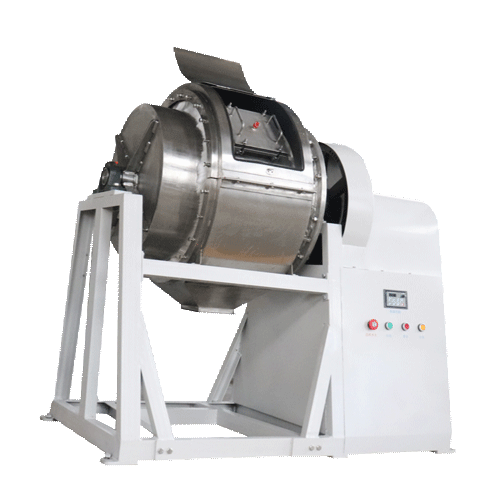
Key operational parameters include:
- Rotational speed: Typically operated at 65% to 75% of the critical speed to maintain effective cascading without centrifugation.
- Media size and filling ratio: Smaller media produce finer particles, while a higher filling ratio (usually 30-40% of mill volume) increases grinding intensity.
- Grinding time: Ranges from minutes to hours, depending on the desired fineness and material properties.
- Wet or dry mode: Wet milling with a liquid vehicle (e.g., water, ethanol) can reduce agglomeration and achieve finer dispersions.
Core Components and Key Technologies
Unlike standard roll ball mills without linings, the inner lined version incorporates several distinctive components that enhance its performance and versatility:
1. Inner Lining Materials
The choice of lining material directly affects the mill's applicability. Common options include:
- Alumina (Corundum) Lining: High hardness, excellent wear resistance, and low contamination; suitable for hard and abrasive materials like ceramics, minerals, and glass.
- Polyurethane Lining: Excellent abrasion resistance and lower noise; ideal for soft to medium-hard materials that require minimal metal contamination.
- Rubber Lining: Good impact resistance and cost-effective; often used in mining and cement industries for coarse grinding.
- PTFE Lining: Chemically inert and non-stick; used for grinding corrosive or sticky materials.
2. Roller Drive System
The mill uses friction rollers to rotate the drum. Adjustable speed control allows precise tuning of the rotational speed to match the critical speed of different drum diameters. Some models feature variable frequency drives (VFD) for smooth speed regulation.
3. Mill Jar or Drum
The grinding container can be a fixed drum or a removable jar. For laboratory-scale units, interchangeable jars of different capacities (e.g., 0.5L, 1L, 5L, 10L) are available, allowing flexible batch processing. The inner lining is either bonded to the jar wall or integrated as a replaceable sleeve.
Key Performance Indicators and Selection Guide
When selecting an inner lined roll ball mill, users should evaluate the following metrics:
- Capacity and Throughput: Laboratory models typically handle from 0.5 kg to 10 kg per batch, while industrial models can process hundreds of kilograms per hour. The effective volume of the drum determines the maximum batch size.
- Particle Size Control: The mill can achieve final particle sizes down to 1 micron or less, depending on the grinding conditions. A narrow particle size distribution is achievable due to the consistent residence time and impact mechanism.
- Energy Efficiency: Compared to other mill types, roll ball mills have moderate energy consumption. The inner lining reduces energy loss by minimizing friction between the media and the drum wall.
- Automation and Programmability: Modern units offer digital timers, speed controllers, and even programmable milling cycles (forward/reverse rotation, pause intervals) to optimize results.
- Maintenance and Durability: The replaceable inner lining extends the service life of the drum and simplifies maintenance. Linings can be swapped when worn, avoiding costly replacement of the entire drum.
Application Fields and Selection Recommendations
The inner lined roll ball mill finds extensive use in:
- Advanced Ceramics: Grinding zirconia, alumina, silicon nitride, and other high-purity powders.
- Minerals and Mining: Wet or dry grinding of ores, limestone, quartz, and feldspar.
- Battery Materials: Milling cathode and anode materials (e.g., lithium cobalt oxide, graphite) without metal contamination.
- Pharmaceuticals and Nutraceuticals: Fine grinding of active ingredients and excipients.
- Chemical and Paint Industries: Dispersing pigments, dyes, and fillers.
For laboratories requiring high purity and flexibility, models with alumina or polyurethane linings and interchangeable jars are recommended. For large-scale production, heavy-duty models with rubber or ceramic linings and higher capacity (e.g., 100L or more) are more suitable. Always consider the material's hardness, abrasiveness, and chemical compatibility when choosing the lining material.
References
For more detailed specifications and product configurations, please visit the official product page: Inner Lined Roll Ball Mill.