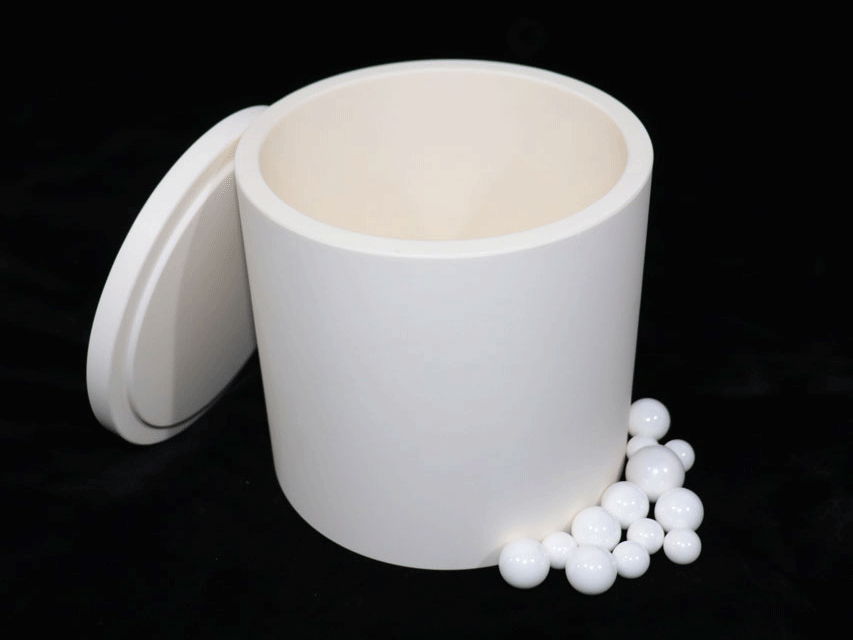
What is a Corundum Planetary Mill Jar? A High-Purity Grinding Container for Contamination-Free Planetary Ball Milling
What is a Corundum Planetary Mill Jar?
From the core, a corundum planetary mill jar is a specialized high-purity grinding container made from dense alumina (corundum) ceramic, designed for use in planetary ball mills. Laboratories and advanced material industries use it to grind, mix, and homogenize solid samples into fine powders or nanometer-sized particles without introducing metallic or organic contaminants. Its exceptional hardness, wear resistance, and chemical inertness make it the ideal choice for applications requiring utmost purity, such as ceramics, electronic materials, and pharmaceutical research.
Core Function and Working Principle
The corundum jar serves as the vessel where the grinding process takes place. When mounted on a planetary ball mill, the jar rotates on its own axis while simultaneously revolving around the main axis of the mill (the planetary motion). This dual rotation creates powerful centrifugal forces that cause the grinding balls inside the jar to collide with the jar walls and each other, effectively crushing and shearing the material trapped between them. The result is a rapid reduction of particle size from coarse granules to micrometer or even sub-micrometer scale.
Unlike metallic jars, the high-purity alumina (Al₂O₃ ≥ 99%) inner surface prevents any metal abrasion from contaminating the sample. The corundum material itself is extremely hard (Mohs hardness 9) and can withstand the high impact forces of planetary ball milling. The grinding efficiency and final particle size are controlled by parameters such as rotation speed, ball-to-powder ratio, grinding time, and the size of the grinding media. For especially reactive or air-sensitive materials, the jar can be equipped with a vacuum sealing lid to maintain an inert atmosphere during milling.
Key Components and Material Technology
The corundum planetary mill jar consists of three main parts: the jar body, the lid, and the sealing gasket. The jar body is precision-molded from high-purity alumina powder and sintered at high temperature to achieve full density and zero porosity. The lid is made of the same corundum material or reinforced with a stainless steel outer shell for added strength. The sealing gasket is typically made of PTFE or silicone rubber to ensure airtightness when using vacuum or gas protection. Compared to jars made of stainless steel, agate, or zirconia, the corundum jar offers a unique balance of extreme hardness, excellent chemical resistance to acids and alkalis, and relatively lower cost, making it a popular choice for routine high-purity grinding.
Key Performance Indicators and Selection Guide
When selecting a corundum planetary mill jar, users should focus on the following factors:
- Volume Capacity: Common sizes range from 100 mL to 5000 mL. Choose a size that matches your sample batch volume and mill capacity.
- Purity Level: Standard corundum jars have 99% Al₂O₃, while A-grade corundum jars reach 99.5% or higher for even stricter contamination control.
- Hardness and Wear Resistance: The higher the density and hardness, the longer the jar lifespan and the lower the abrasion contamination.
- Compatibility with Mill: Ensure the jar's outer dimensions and locking mechanism fit your specific planetary ball mill model (e.g., TENCAN, Retsch, etc.).
- Sealing Performance: For vacuum or inert gas milling, check that the lid and gasket can maintain a stable vacuum level over the grinding cycle.
- Temperature Resistance: Corundum can withstand high temperatures, but sudden thermal shock should be avoided.
In terms of maintenance, the jar is easy to clean with water or mild solvents after use. The hard surface does not absorb residues, minimizing cross-contamination between batches. Regular inspection of the sealing gasket and threads is recommended to ensure long-term airtightness.
Application Fields and Selection Advice
Corundum planetary mill jars are widely used in geology, mineral processing, ceramics, battery materials, catalysts, electronic ceramics, and pharmaceutical research. They are particularly suitable for grinding hard and brittle materials such as quartz, feldspar, alumina, silicon carbide, and various oxides. For materials that are highly sensitive to iron contamination (e.g., white ceramics, high-purity optical materials), the corundum jar is the preferred choice over stainless steel or other metal jars. If the material requires extreme fineness below 100 nanometers, a zirconia jar may offer better grinding efficiency due to its higher density, but corundum provides a more cost-effective solution for most micro-level grinding tasks.
For users just starting with planetary ball milling, a 500 mL corundum jar paired with matching corundum grinding balls is a reliable and versatile combination. For industrial-scale production, larger jars up to 5 L can be used with heavy-duty mills. Always refer to the manufacturer's specifications to ensure optimal performance and safety.
References