
What is a Colloid Mill? A High-Speed Wet Grinding and Emulsifying Equipment for Fine Processing of Liquid and Semi-Liquid Materials
What is a Colloid Mill? A High-Speed Wet Grinding and Emulsifying Equipment
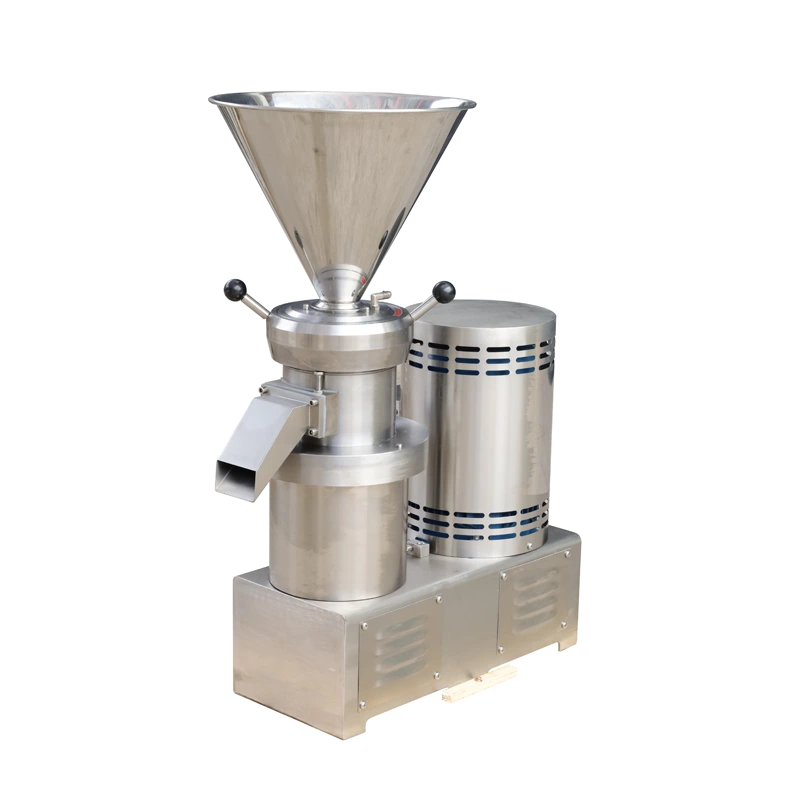
At its core, a colloid mill is a specialized high-speed wet grinding machine that industries such as food processing, chemicals, pharmaceuticals, cosmetics, and new materials use to perform emulsification, dispersion, homogenization, and ultra-fine grinding of liquid or semi-liquid materials. It is also known as a wet ultrafine pulverizer, colloidal mill, or colloid grinder. The equipment converts coarse suspensions or emulsions into stable, homogeneous colloidal systems with particle sizes down to the micron level.
Core Function and Working Principle
The primary function of a colloid mill is to transform materials from a coarse liquid-liquid or liquid-solid mixture into a finely dispersed, stable colloidal state. The core working principle is based on the rotor-stator mechanism: a high-speed rotating rotor (cone or disc) operates in close proximity to a stationary stator, leaving an adjustable gap (typically 0.1–5 mm). The material enters the gap between the rotor and stator teeth and is subjected to intense shear forces, friction, high-frequency vibration, and hydraulic shear. This intense mechanical action breaks down droplets or solid particles to the micron or even submicron range, creating a uniform emulsion or suspension.
Key process parameters include the rotor speed (typically 1,400–18,000 rpm, with linear speeds up to 44 m/s), the gap width (adjustable via a handwheel or control system), and the number of passes through the mill. The design often features three grinding zones for progressive refinement. The product temperature can rise due to shear heating, so many models incorporate cooling jackets for temperature-sensitive materials.
Main Types and Classifications
Colloid mills are available in several structural configurations to suit different production scales and material properties:
Vertical (Direct-drive) Colloid Mill
The motor is mounted directly above the grinding head, providing a compact footprint and easy maintenance. Suitable for low-to-medium viscosity materials and laboratory or pilot-scale operations.
Split-type (Side-drive) Colloid Mill
The motor is mounted separately beside the machine body and drives the rotor via a belt. This design offers better cooling, facilitates belt replacement, and allows higher torque for viscous materials. Many industrial models adopt this configuration.
Horizontal Colloid Mill
The rotor shaft is horizontally oriented. Ideal for high-viscosity pastes (e.g., peanut butter, paints) and continuous processing lines. Often features a more robust bearing system.
In-line / Pipeline Colloid Mill
Integrated directly into a pipeline system for continuous, closed-loop processing. Suitable for large-flow production (up to 125 t/h) and applications requiring high throughput with minimal operator intervention.
Fully Enclosed / Closed Colloid Mill
Designed for volatile, flammable, or highly hygiene-sensitive materials. It operates in a sealed environment to prevent solvent evaporation, contamination, or explosion, making it ideal for fragrances, pharmaceutical intermediates, and bio-active compounds.
Key Performance Indicators and Selection Criteria
When selecting a colloid mill, consider the following critical performance metrics:
- Processing capacity / Throughput: Ranges from laboratory models handling ~0.1 L/min to industrial units exceeding 100,000 L/h. Choose based on your required batch size or continuous output.
- Particle size / Fineness: Most colloid mills can achieve particle sizes between 2 and 50 microns. High-shear models may reach submicron levels (0.5–5 µm) with multiple passes.
- Viscosity handling: Standard models handle 5,000–10,000 cP; heavy-duty versions can process up to 20,000+ cP (e.g., heavy pastes, modified bitumen).
- Rotational speed control: Some models offer variable-frequency drive (VFD) for adjusting shear intensity and adapting to different materials.
- Materials of construction: Contact parts are typically stainless steel (304 or 316L) for corrosion resistance and hygiene. Rotor/stator materials may include hardened alloy steel, ceramic, or tungsten carbide for abrasive applications.
- Cleaning and sterilization: For food and pharmaceutical use, look for CIP (Clean-in-Place) and SIP (Sterilize-in-Place) capabilities, plus FDA or GMP compliance.
- Maintenance and ease of use: Quick-gap adjustment mechanisms, easy disassembly for cleaning, and accessible wearing parts (e.g., mechanical seals, grinding discs) are important for long-term operational efficiency.
Application Areas and Selection Advice
Colloid mills are indispensable in a wide range of industries:
- Food & Beverage: Emulsifying sauces, dressings, creams, fruit juices, chocolate, peanut butter, and dairy products.
- Chemical & Petrochemical: Manufacturing paints, adhesives, coatings, modified bitumen, and lubricants.
- Pharmaceutical & Biotech: Producing oral suspensions, ointments, emulsions, and nanomedicines under sterile conditions.
- Cosmetics & Personal Care: Making lotions, creams, sunscreens, and toothpaste.
- New Materials: Dispersing carbon black, titanium dioxide, graphene, and ceramic slurries.
- Laboratory & R&D: Small-scale testing of formulations and process development.
Selection tips: For laboratory or R&D work, choose a compact vertical or bench-top model with a small footprint and adjustable speed. For pilot-scale or small production, a split-type or horizontal design offers flexibility and decent throughput. For high-volume continuous production, consider an in-line colloid mill. If your material is volatile or requires a sterile environment, opt for a fully enclosed model with explosion-proof or sanitary features.
Finally, always consult the manufacturer’s technical team to match the mill’s wetted materials, rotor-stator geometry, and motor power to your specific formulation viscosity and target fineness.