
What is a Planetary Ball Mill (Semi-Circular Model)? A High-Energy Grinding Device for Laboratory Nano-Powder Preparation
Introduction
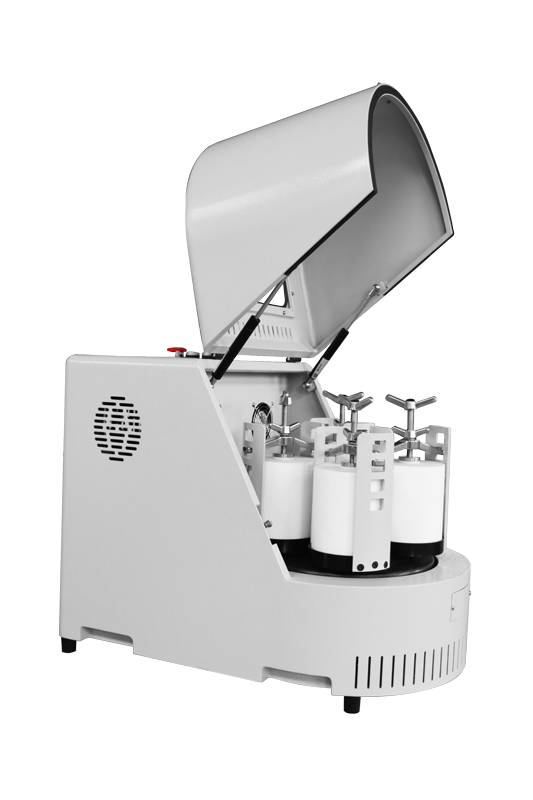
At its core, a planetary ball mill (semi-circular model) is a specialized high-energy grinding device used in laboratories and research institutions to transform coarse solid materials into ultra-fine powders, often reaching the nanometer scale. It is the go-to equipment for tasks such as mechanical alloying, mechanical activation, and mechanochemistry, where intense milling energy is required to achieve desired material properties. The semi-circular design distinguishes it from square or full-directional models, offering a compact and efficient solution for routine sample preparation.
Core Function and Working Principle
The planetary ball mill operates on a principle inspired by the solar system: a central sun wheel (main disk) rotates, carrying multiple grinding jars (planets) that rotate on their own axes in the opposite direction. This combination of revolution and rotation generates powerful centrifugal and Coriolis forces, driving the grinding balls inside the jars to collide, shear, and rub against the material at high speeds. The semi-circular model features a rounded grinding chamber that enhances the flow of material and balls, reducing dead zones and improving grinding uniformity.
This high-energy milling action can reduce particle sizes down to 0.1 μm or even finer, depending on the material, milling time, and ball-to-powder ratio. The process can be performed dry, wet, or under an inert gas atmosphere using vacuum or gas-tight jars. Key parameters such as rotational speed, milling duration, and interval pauses are precisely controlled via a touch screen or button interface, allowing reproducible results across batches.
Key Features of the Semi-Circular Model
The semi-circular design offers several advantages over traditional square or rectangular models:
- Efficient Material Flow: The curved interior prevents material accumulation in corners, promoting uniform grinding and reducing cleaning time.
- Compact Footprint: The semi-circular housing is space-saving, ideal for crowded laboratory benches.
- Enhanced Safety: A sealed grinding chamber with a transparent observation window allows monitoring while protecting operators from dust and noise.
- Versatile Jar Compatibility: It accepts various jar materials (stainless steel, zirconia, agate, PTFE, etc.) to avoid cross-contamination.
Performance Indicators and Selection Guide
When selecting a planetary ball mill semi-circular model, consider the following critical parameters:
- Processing Capacity: Typically available in jar volumes from 0.2 L to 10 L, suitable for small to medium batch grinding.
- Rotational Speed Range: The sun wheel speed usually ranges from 50 to 450 rpm, with jar speeds up to 900 rpm (depending on the transmission ratio). Higher speeds yield higher impact energy but may generate heat.
- Control System: Modern models feature programmable logic controllers (PLC) with touch screens, allowing setting of speed, time, direction, and interval cycles. Memory functions preserve settings after power loss.
- Noise Level: Quality mills operate around 60 dB, making them suitable for quiet lab environments.
- Safety Features: Overload protection, emergency stop button, and interlock switches are essential for safe operation.
For labs focused on nano-materials or mechanical alloying, a model with higher speed and robust construction is recommended. For routine sample preparation of soils, ceramics, or pharmaceuticals, a standard semi-circular model with adequate jar volume and automation will suffice.
Application Fields
The planetary ball mill semi-circular model is widely used in:
- Materials Science: Preparation of ceramic powders, metal oxides, catalysts, and nanocomposites.
- Chemistry: Mechanochemical synthesis, mixing of solid reagents, and activation of precursors.
- Environmental Testing: Grinding of soil, sediment, and plant tissues for contaminant analysis.
- Pharmaceuticals: Size reduction of active ingredients and excipients for drug formulation.
- Geology and Mining: Pulverization of rock samples for mineralogical analysis.
For detailed specifications and to explore the full range of planetary ball mills, please visit the product page or browse related models such as the vertical square planetary ball mill and the micro-computerized touch screen planetary ball mill.