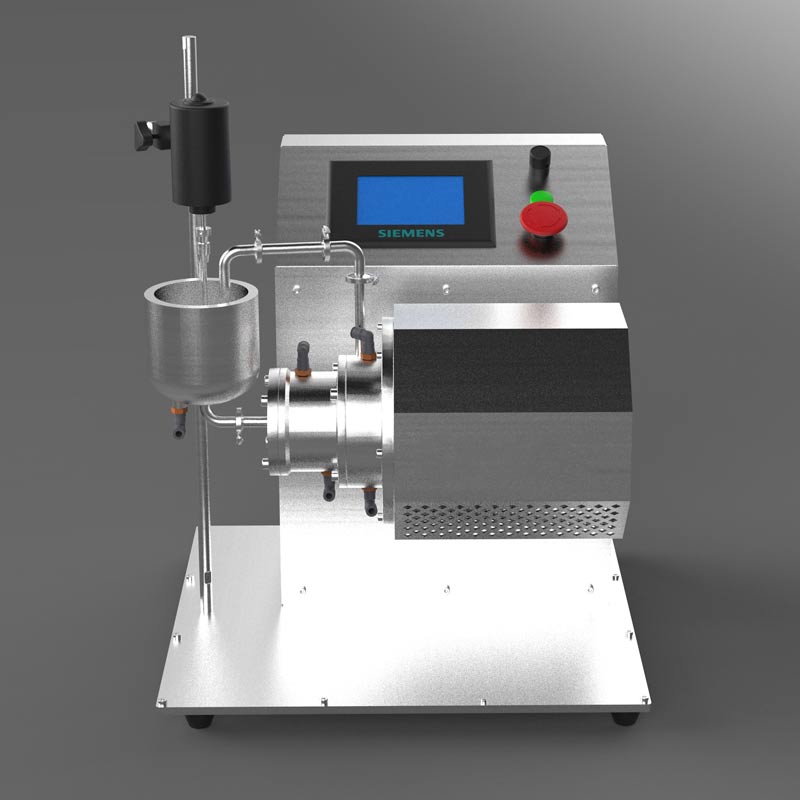
What is a Lab Horizontal Bar Pin Nano Sand Mill? A Wet Grinding Equipment for Nano-Scale Material Dispersion
What is a Lab Horizontal Bar Pin Nano Sand Mill?
At its core, a lab horizontal bar pin nano sand mill is a specialized wet grinding and dispersing machine designed for research laboratories, pilot plants, and small-batch production. It is used to break down agglomerates and reduce particle size of solid materials in liquid suspensions down to the nanometer range (typically 50–200 nm). The mill achieves this through intense mechanical energy imparted by a rotating pin-type rotor (bar pin) inside a horizontal grinding chamber filled with fine ceramic beads (grinding media). This equipment is essential for the development of advanced materials such as nano-coatings, conductive inks, pharmaceutical suspensions, and battery electrode slurries.
Core Function and Working Principle
The lab horizontal bar pin nano sand mill transforms a coarse pre-mixed slurry into a stable, finely dispersed nano-suspension. The key working mechanism involves three main components:
1. Grinding Chamber: A horizontal cylinder lined with wear-resistant materials (e.g., zirconia or polyurethane) to prevent metal contamination.
2. Bar Pin Rotor: A shaft equipped with multiple rows of pins or bars that rotate at high speed (typically 1,000–3,000 rpm). The rotor design creates a strong turbulent flow, forcing the grinding media and slurry particles to collide, shear, and rub against each other.
3. Dynamic Separation System: A gap separator or centrifugal separator at the outlet retains the grinding media inside the chamber while allowing the finely ground product to exit continuously.
During operation, the slurry is pumped into the chamber through the inlet. The high-speed rotation of the bar pin rotor energizes the grinding beads, generating intense impact and shear forces that break down solid particles. The residence time, rotor speed, bead size (0.1–1.0 mm), and feed rate are critical parameters that affect the final particle size distribution. The machine can operate in either pass mode or recirculation mode, depending on the required fineness.
Key Components and Technology
Unlike conventional ball mills, the lab horizontal bar pin nano sand mill employs a pin-type rotor instead of simple discs. The bar pin design provides:
- Higher energy density: More contact points between beads and pins, resulting in faster grinding (up to 50% shorter processing time).
- Narrower particle size distribution: Uniform stress distribution ensures consistent grinding.
- Better adaptability: Suitable for both low-viscosity and high-viscosity slurries.
Most laboratory models feature a double mechanical seal with coolant circulation to prevent leakage and maintain stable operation. The grinding chamber volume typically ranges from 0.3 L to 5 L, ideal for small sample volumes. Advanced models include PLC touchscreen control, variable frequency drives, and temperature monitoring systems to protect heat-sensitive materials.
Key Performance Indicators and Selection Criteria
When selecting a lab horizontal bar pin nano sand mill, consider the following metrics:
1. Grinding Fineness and PDI
High-quality mills achieve a stable particle size of 50–200 nm with a Polydispersity Index (PDI) below 0.3. Entry-level equipment may only reach 300–500 nm with wider distribution.
2. Chamber Volume and Processing Capacity
Laboratory mills typically offer 0.3 L, 1 L, or 5 L chambers. For small R&D batches, 0.3–1 L is sufficient; for pilot-scale trials, 5 L models are preferred.
3. Rotor Speed and Power
Motor power ranges from 1.5 kW to 5 kW, with speeds up to 3,000 rpm. Higher speed enables finer grinding but requires better cooling.
4. Material of Construction
Zirconia ceramic lining is recommended for high-purity applications (e.g., pharmaceuticals, electronics). Polyurethane lining is suitable for general coatings and inks.
5. Cooling and Stability
Continuous operation for 24 hours requires effective cooling to keep the slurry temperature below 40°C, especially for heat-sensitive materials.
6. Ease of Cleaning
Quick-release chamber designs and separate control cabinets simplify maintenance and prevent cross-contamination between batches.
Application Fields and Selection Advice
The lab horizontal bar pin nano sand mill is widely used in:
- Coatings & Inks: Nano-pigment dispersion for high-gloss, high-clarity products.
- Electronics & Battery Materials: Conductive carbon black, silver nanoparticles, and cathode/anode slurries.
- Pharmaceuticals & Cosmetics: Nano-suspensions for improved bioavailability and skin penetration.
- Advanced Ceramics & Functional Materials: Nano-scale alumina, zirconia, and rare-earth oxides.
For laboratories exploring new formulations, a compact 1L model with recirculation capability is recommended. For pilot production aiming at scale-up, a 5L model with a wider flow range and robust sealing is more suitable. Always verify the manufacturer's track record in producing genuine self-developed equipment to avoid common issues like metal contamination, clogging, or unstable temperature control.