
What is a Lightweight Vibrating Ball Mill? An Efficient Grinding Device for Rapid, Ultra-fine Sample Preparation in the Laboratory
What is a Lightweight Vibrating Ball Mill?
At its core, a lightweight vibrating ball mill is a specialized laboratory grinding device that uses high-frequency mechanical vibration to rapidly reduce solid materials into fine or ultra-fine powders. Researchers and technicians in materials science, geology, chemistry, and pharmaceuticals use it to achieve quick, reproducible pulverization for sample preparation, new material development, and quality control.
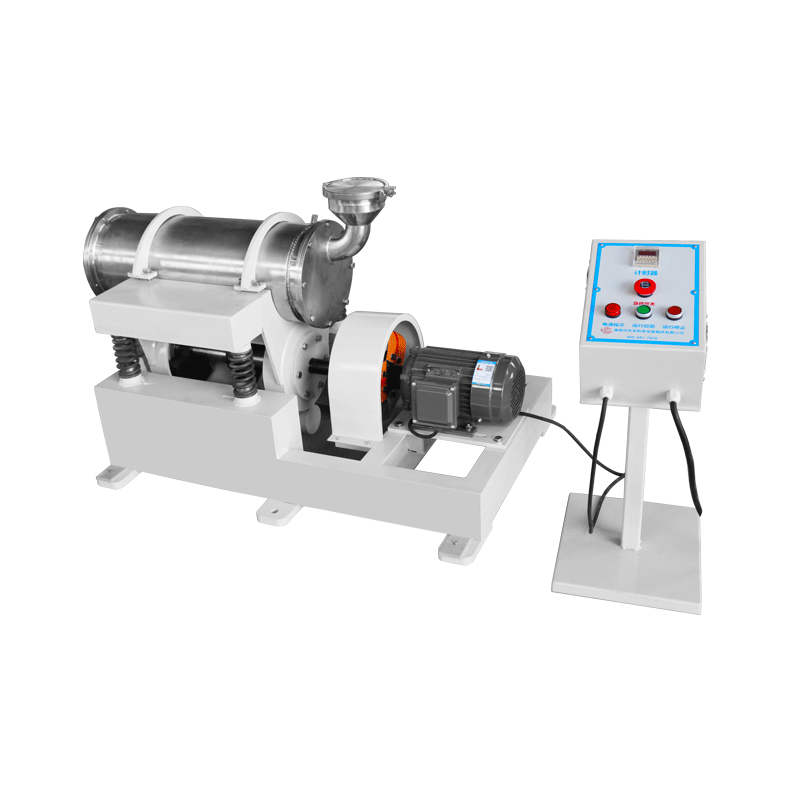
Core Function and Working Principle
The fundamental function of a lightweight vibrating ball mill is to transform coarse materials into fine powders through a combination of impact, friction, and shear forces. Unlike traditional rotary ball mills that rely on the rotational movement of a drum, this device operates by oscillating the entire grinding chamber at high frequencies (typically 800–1500 rpm) and small amplitudes (a few millimeters).
Inside the grinding bowl, balls made of materials such as agate, zirconia, or stainless steel are set into rapid, chaotic motion by the vibration. As the balls collide and rub against each other and the bowl walls, they trap and break down the sample particles. The high energy density and frequent collisions allow for extremely fast grinding times – often reducing samples to micron or even nanometer sizes within minutes. Key process parameters include vibration frequency, amplitude, grinding media size and material, and the ball-to-sample weight ratio.
Key Components and Design Features
A lightweight vibrating ball mill typically consists of a robust base with a vibration motor, a spring suspension system, and one or more grinding bowls. The bowl can be hermetically sealed for wet or dry grinding under controlled atmospheres or even vacuum. The compact design makes it ideal for benchtop use, and its low weight allows for easy relocation between workstations. Many models offer programmable timers and variable speed controls to optimize grinding conditions for different materials.
Key Performance Indicators and Selection Criteria
When selecting a lightweight vibrating ball mill, consider the following critical parameters:
- Grinding capacity: Typical bowl volumes range from 50 mL to 500 mL, suitable for gram-scale samples.
- Final particle size: Most units can achieve ultrafine grinds down to 1–10 μm, with some capable of submicron or nano-scale results.
- Vibration frequency and amplitude: Higher frequencies yield faster grinding but may generate more heat; adjustable controls are preferred.
- Material of construction: The bowl and balls must be chemically compatible with the sample to avoid contamination.
- Automation and programmability: Digital timers and memory presets improve reproducibility and operational ease.
- Maintenance: Simple bowl exchange and easy access to vibration components ensure long service life.
Applications and Selection Guidance
This versatile mill is widely used for grinding a vast array of materials, including minerals, ores, ceramics, chemicals, pharmaceuticals, biological samples, and electronic materials. It is especially popular in research labs where sample quantities are small but rapid turnaround is essential. For users requiring routine preparation of multiple samples, consider models with multi-bowl adapters or larger bowl capacities. For heat-sensitive materials, a liquid nitrogen cooling accessory or intermittent operation may be necessary.
For more details, visit the product page: Lightweight Vibrating Ball Mill or explore related models like the Lab Vibration Ball Mill and Heavy Duty Vibrating Ball Mill for larger capacity needs.