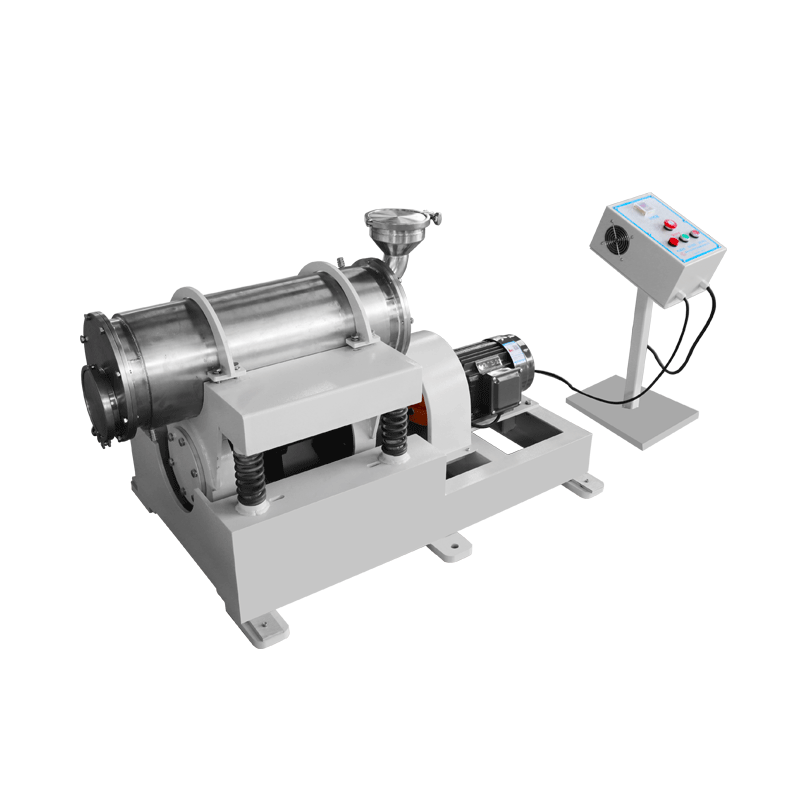
What is a Lightweight Vibrating Ball Mill? A High-Efficiency Grinding Device for Rapid Fine Powder Preparation in Laboratories
What is a Lightweight Vibrating Ball Mill?
At its core, a lightweight vibrating ball mill is a specialized laboratory grinding device that researchers and technicians use to rapidly reduce solid materials into fine powders through high-frequency vibration. Unlike traditional ball mills that rely on rotation, this equipment uses oscillatory motion to create intense impact and friction between the grinding media and the sample, achieving ultrafine grinding in a fraction of the time. It is an essential tool for sample preparation in materials science, chemistry, geology, and pharmaceuticals.
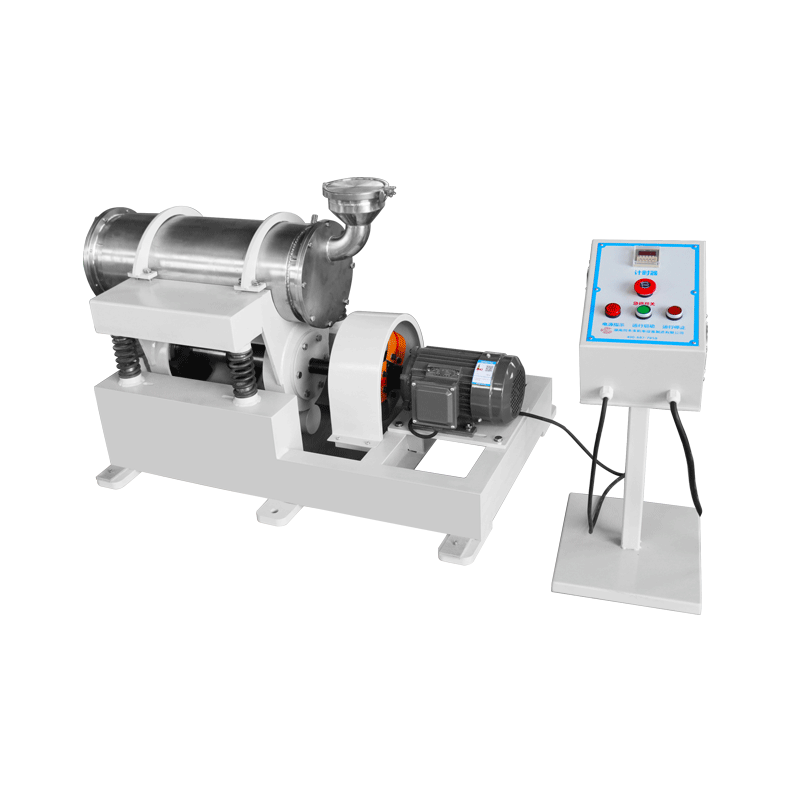
Core Function and Working Principle
The primary function of a lightweight vibrating ball mill is to transform coarse materials (typically from a few millimeters down to <1 mm) into a fine powder with particle sizes ranging from tens of microns down to sub-micron levels. The working principle is based on mechanical vibration: the grinding chamber, which is partially filled with grinding balls (commonly made of agate, zirconia, or stainless steel) and the material to be ground, is subjected to rapid oscillations—usually in a three-dimensional path—at frequencies of 10–30 Hz. This vibration causes the grinding media to collide with each other and with the chamber walls, generating high-energy impact, shearing, and attrition forces that break down the material particles.
The key advantage of this method is the extremely high energy density. Because the vibration amplitude and frequency can be precisely controlled, the mill can achieve much finer particle sizes in a shorter time compared to conventional planetary ball mills. The final particle size distribution is influenced by parameters such as vibration frequency, amplitude, grinding ball size, ball-to-powder ratio, and grinding time. Typical grinding times range from 10 minutes to a few hours, depending on the target fineness.
Main Types of Lightweight Vibrating Ball Mills
While the lightweight vibrating ball mill is a specific category, it can be further divided based on configuration and application:
Single-Chamber Vibrating Ball Mill
This is the most common type, consisting of a single grinding chamber mounted on a vibrating platform. It is ideal for routine sample preparation where only one material is processed at a time. The compact design makes it highly portable and easy to clean.
Multi-Chamber Vibrating Ball Mill
Some models feature two or more grinding chambers mounted on the same vibrating base. This allows simultaneous grinding of multiple samples under identical conditions, greatly improving throughput for laboratories that need to process several batches in parallel.
Cryogenic Vibrating Ball Mill
For heat-sensitive or elastic materials (such as polymers, rubber, or biological tissues), a cryogenic version can be used. The grinding chamber is pre-cooled with liquid nitrogen to embrittle the sample, enabling efficient grinding without thermal degradation.
Key Performance Indicators and Selection Guidelines
When selecting a lightweight vibrating ball mill, consider the following critical parameters:
Processing Capacity: Most laboratory models handle sample volumes from 5 mL to 100 mL per batch. Choose a capacity that matches your typical sample size without overloading the mill.
Fineness and Particle Size Distribution: The achievable final fineness depends on the grinding media and machine settings. High-end models can produce particles down to <1 µm. Look for models that offer adjustable vibration frequency and amplitude for fine-tuning.
Energy Efficiency: Lightweight vibrating ball mills generally consume less power than planetary ball mills of similar capacity. Check the motor power (typically 100–500 W) and whether the machine has energy-saving features.
Automation and Programmability: Many modern models include digital timers, programmable grinding cycles, and even touch-screen interfaces. These features improve reproducibility and ease of use.
Maintenance and Durability: Since the vibrating mechanism experiences high mechanical stress, ensure the mill uses robust bearings and a sturdy frame. Easy access to the grinding chamber for cleaning and media replacement is also important.
Application Areas and Selection Advice
Lightweight vibrating ball mills are widely used in:
- Materials Research: Grinding of ceramics, alloys, composites, and nanomaterials.
- Geology and Mining: Sample preparation for X-ray diffraction (XRD) and chemical analysis of rocks, ores, and minerals.
- Pharmaceuticals: Fine grinding of active pharmaceutical ingredients (APIs) and excipients.
- Chemistry and Chemical Engineering: Catalyst preparation, pigment dispersion, and mechanical alloying.
- Food and Agriculture: Grinding of seeds, grains, and dried plant materials for analysis.
For researchers who need rapid, fine grinding of small samples (typically <50 g) and value portability and low noise, the lightweight vibrating ball mill is an excellent choice. If you require higher throughput or larger quantities, consider the Heavy Duty Vibrating Ball Mill or the Lab Vibration Ball Mill series for more options.