
What is a Vertical Production Planetary Ball Mill? A High-Throughput Milling Equipment for Industrial-Scale Ultrafine Grinding
Introduction
From the core, a Vertical Production Planetary Ball Mill is a specialized high-energy milling device designed for industrial-scale ultrafine grinding. Industries such as powder metallurgy, advanced ceramics, battery material manufacturing, chemicals, and mineral processing use this equipment to efficiently reduce coarse particles or granules into fine powders, often reaching sub-micron or even nanometer dimensions. Unlike laboratory benchtop models, the production version emphasizes higher throughput, continuous operation capability, and robust construction for demanding 24/7 production environments.
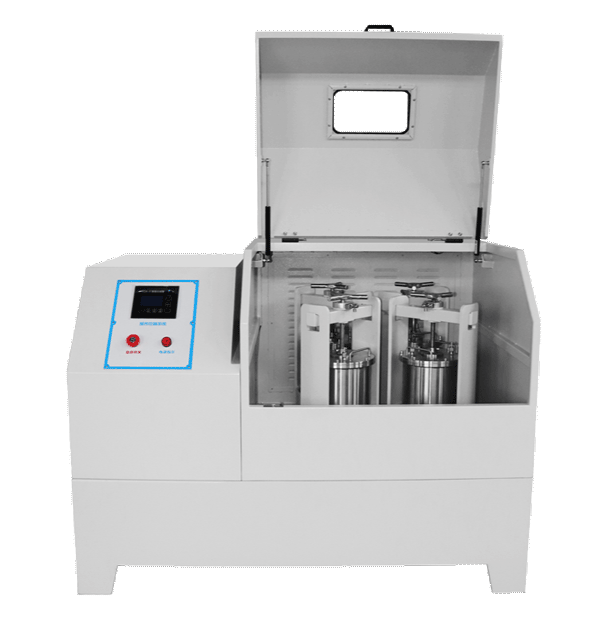
Core Function and Working Principle
The fundamental function of the Vertical Production Planetary Ball Mill is to transform feed materials from millimeter-sized particles into microscale or nanoscale powders through intense mechanical impact and friction. The key innovation lies in its planetary motion: the grinding jars mounted on a rotating sun wheel not only revolve around the central axis (like planets orbiting the sun) but also spin rapidly on their own axes. This combination of revolution (public rotation) and rotation (self-rotation) creates extremely high centrifugal forces – up to dozens of times the acceleration of gravity – causing the grinding balls inside the jars to collide violently with the material and the jar wall.
During operation, the grinding media (typically balls made of zirconia, agate, stainless steel, or tungsten carbide) are accelerated to high speeds, generating three main comminution mechanisms: impact (direct collision between balls and material), compression (squeezing between balls and jar wall), and shear/friction (rubbing between moving balls). The vertical configuration ensures that the grinding jars remain in a stable upright position, allowing easy loading/unloading and minimal material spillage – a critical advantage for production lines where dust containment and repeatability are vital.
Key Process Parameters
Several adjustable parameters influence the final particle size and uniformity:
- Rotation speed – higher speeds increase energy input but may cause excessive heat; optimal speeds are typically 60–600 rpm for production mills.
- Grinding time – can range from minutes to hours depending on target fineness; many models offer programmable timers for consistent batch quality.
- Ball-to-powder ratio – typically between 10:1 and 20:1 by weight; higher ratios accelerate grinding but reduce batch capacity.
- Grinding media size – smaller balls (e.g., 0.1–5 mm) are preferred for nanoscale grinding; larger balls for coarse pre-milling.
- Atmosphere control – vacuum or inert gas grinding is possible with specialized jars, preventing oxidation or contamination of sensitive materials.
Core Components and Key Technologies
While the Vertical Production Planetary Ball Mill shares the basic planetary architecture with laboratory versions, its production-grade design incorporates several critical enhancements:
Driving System and Gearbox
A high-torque motor coupled with a precision gear transmission ensures stable speed even under heavy loads. Some advanced models adopt dual-drive systems or frequency inverters for smooth startup and speed regulation.
Grinding Jar Assemblies
Production mills often feature interchangeable jars made from various materials (stainless steel, ceramic, polyurethane, etc.) to avoid cross-contamination. Jars typically have capacities from 2 L to 20 L per station, and multiple stations (2, 4, or 6) work simultaneously to quadruple throughput.
Touchscreen Control System
Modern production mills are equipped with microcomputer touchscreen interfaces, allowing operators to program forward/reverse rotation, pause intervals, total run time, and acceleration profiles. This automation ensures batch reproducibility and reduces human error. Some models include real-time monitoring of temperature, vibration, and power consumption.
Key Performance Indicators and Selection Criteria
When selecting a Vertical Production Planetary Ball Mill, consider the following metrics:
- Throughput capacity – typically expressed in kilograms or liters per batch; for continuous models, in kg/h. Production mills can process tens of kilograms per batch, far exceeding lab mills.
- Final particle size – the minimum achievable size depends on material properties, media selection, and process optimization. Many machines can reach D50 < 1 μm (submicron) or even < 100 nm with suitable conditions.
- Energy efficiency – planetary mills are inherently energy-intensive; look for models with high-efficiency motors and optimized transmission to reduce operating costs.
- Automation level – fully programmable units with data logging and optional remote monitoring are preferable for consistent production.
- Maintainability – quick-release jar clamps, easy-access panels, and replaceable wear parts (e.g., jar lids, sealing gaskets) minimize downtime.
- Noise and safety – production mills should incorporate soundproof enclosures, interlock systems, and emergency stop functions to meet workplace safety standards.
Application Areas and Selection Advice
The Vertical Production Planetary Ball Mill is widely used in:
- Battery material preparation – grinding of cathode/anode powders, solid electrolytes, and conductive additives.
- Advanced ceramics – producing ultrafine alumina, zirconia, silicon carbide, and other structural or functional ceramics.
- Powder metallurgy – mechanical alloying and refining of metal powders for MIM or additive manufacturing.
- Pharmaceuticals and cosmetics – micronizing active ingredients, pigments, and excipients.
- Geology and mining – sample preparation for XRF analysis or ore beneficiation studies.
Selection guidance: For small-scale production (a few kg per batch), a 2–4 liter vertical planetary mill with four stations is a cost-effective choice. For larger volumes, consider 10 L or higher capacity models with continuous operation features. If your materials are heat-sensitive or prone to oxidation, opt for a model with cooling jacket and vacuum/inert gas capability. Always request test grinding reports from the manufacturer to verify that the machine can achieve your desired particle size distribution.
References
For more technical details and product specifications, please visit the official product page: Vertical Production Planetary Ball Mill. Explore the full range of planetary ball mills at Planetary Ball Mill Series.