
What is a Vertical Square Planetary Ball Mill? A High-Performance Grinding Mill for Ultra-Fine Powder Production in Laboratories
Introduction
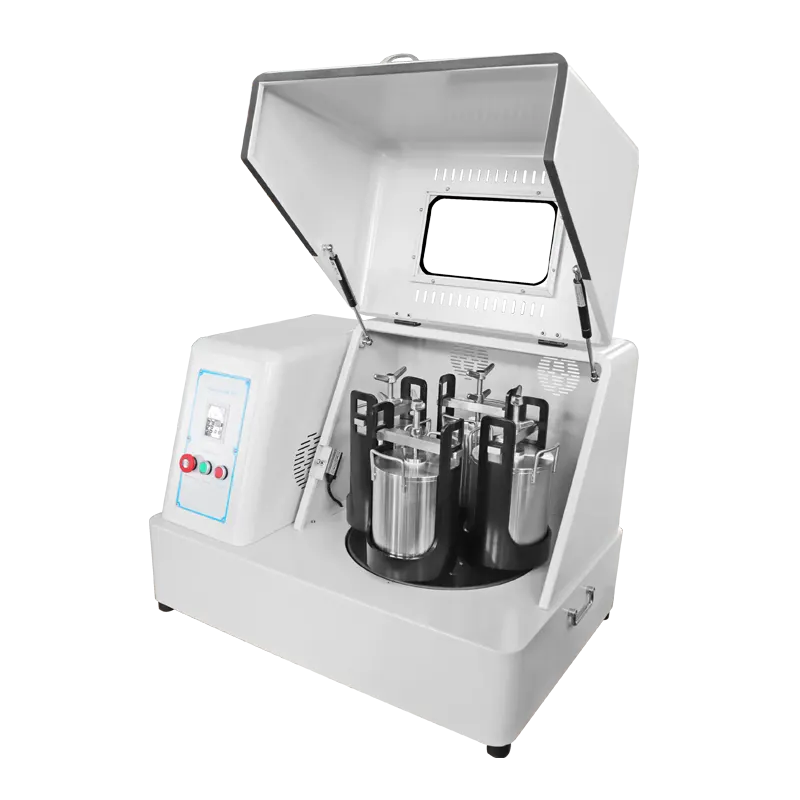
At its core, the vertical square planetary ball mill is a specialized laboratory grinding mill designed for mixing, fine grinding, and preparing small-volume high-tech materials. Researchers and engineers in materials science, geology, mining, chemistry, and pharmaceuticals use it to achieve ultra-fine powders down to the nanometer scale through a unique planetary motion mechanism. Unlike conventional ball mills, the vertical square design offers enhanced stability, space efficiency, and ease of operation, making it an indispensable tool for R&D and small-scale production.
Core Function and Working Principle
The primary function of a vertical square planetary ball mill is to transform coarse materials (e.g., powders, granules, or small lumps) into fine or ultra-fine powders through a combination of impact, friction, and shear forces. The mill consists of a rotating base (the sun wheel) and several grinding jars (satellites) that rotate simultaneously around their own axes in opposite directions. This configuration creates a planetary motion: the jars revolve around the center of the sun wheel while spinning at high speed, generating intense centrifugal forces that drive the grinding balls to collide with the material repeatedly.
Inside the sealed grinding jar, the material is subjected to high-energy impacts from the milling media (e.g., balls made of zirconia, agate, or stainless steel). The speed ratio between the sun wheel and the jars typically ranges from 1:2 to 1:3, producing accelerations up to 20 times the force of gravity. The grinding time, ball size, and material-to-ball ratio are critical parameters that influence final particle size and distribution. For example, a longer grinding time with smaller balls can yield particles as fine as 0.1 microns, ideal for advanced ceramics, battery materials, and nanocomposites.
Key Design Features and Technologies
While the vertical square planetary ball mill belongs to the planetary ball mill family, its distinct design offers several advantages:
Square Vertical Structure
Unlike traditional round or semi-circular models, the square housing provides a more stable footprint and allows for easy stacking or integration into glove boxes. The vertical orientation minimizes the floor space required while maintaining a low center of gravity, reducing vibration during operation.
Planetary Mechanism with Variable Speed Control
The mill features a programmable speed control system (typically touch-screen or microcomputer-based) that enables precise adjustment of rotation speed, direction, and running time. Users can set cycles with forward and reverse rotation to ensure uniform grinding and avoid sedimentation.
Locking Clamps and Safety Interlocks
Advanced models include automatic locking clamps that secure the grinding jars in place. The mill also has safety interlocks that prevent operation when the lid is open, ensuring user protection.
Optional Vacuum or Inert Atmosphere Grinding
With optional vacuum jars, the mill can grind samples under vacuum or inert gas (e.g., argon, nitrogen), which is crucial for air-sensitive materials like metal powders, lithium battery materials, or catalysts.
Key Performance Indicators and Selection Criteria
When selecting a vertical square planetary ball mill, consider the following parameters:
- Processing Capacity: Typically ranges from 0.2 L to 4 L total volume (e.g., 4 jars x 500 mL). Choose a model that matches your batch size.
- Grinding Fineness: The ability to achieve sub-micron or nanometer particles depends on the maximum speed (typically 400–600 rpm), ball material, and grinding time. Higher speeds produce finer powders but may increase wear.
- Speed Control and Programmability: Look for a unit with a programmable controller that allows setting speed, time, and pause cycles. Touch-screen interfaces offer ease of use and data logging.
- Material of Construction: The housing and internal components should be robust. Stainless steel with a durable coating is common. The grinding jars and balls must be compatible with the sample (e.g., zirconia for ceramics, agate for silicates).
- Noise and Vibration: High-quality planetary mills are designed to operate quietly and with minimal vibration. Check the decibel rating and stability at maximum speed.
- Maintenance and Accessories: Consider the ease of replacing grinding jars, seals, and belts. Availability of different jar materials (nylon, Teflon, tungsten carbide, etc.) is important for versatile applications.
Applications and Selection Advice
Vertical square planetary ball mills are widely used in: geology and mining (sample preparation for XRF or XRD), ceramics (nanopowder synthesis), pharmaceuticals (micronization of active ingredients), electronics (battery material grinding), and environmental science (soil homogenization). For laboratories that require frequent change of materials or work with toxic/hazardous substances, models with optional vacuum/inert gas capability and easy-to-clean jars are recommended. For high-throughput applications, a dual-station or multi-jar design can improve productivity.
For first-time buyers, starting with a mid-range model (e.g., 0.4L total volume with zirconia jars) is a cost-effective way to test the technology. Professional users aiming for reproducible results should consider units with touch-screen control and data export features.