
What is a Production Type Sand Mill? A Continuous Wet Grinding Mill for Industrial Nano-Scale Dispersion
What is a Production Type Sand Mill? A Continuous Wet Grinding Mill for Industrial Nano-Scale Dispersion
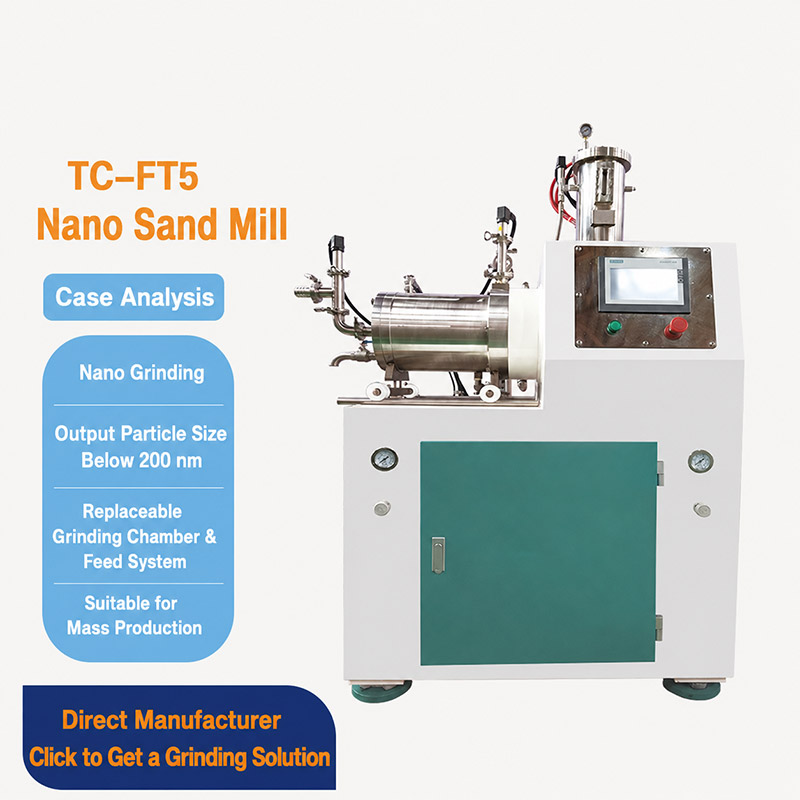
At its core, a production type sand mill is a high-efficiency wet grinding equipment designed for continuous industrial-scale dispersion and nanomilling. It is used by manufacturers in industries such as lithium battery materials, functional ceramics, printing inks, coatings, and advanced chemicals to break down solid particles in liquid suspensions to sub-micron or even nanometer particle sizes. Unlike batch processes, it allows continuous feeding and discharging, greatly improving production throughput and consistency.
Core Function and Working Principle
The production type sand mill transforms a slurry of coarse particles into a stable, finely dispersed suspension. The core working element is a grinding chamber filled with small grinding media (typically 0.1–2.0 mm zirconia or glass beads). A high-speed rotor equipped with pins, discs, or bars agitates the media, creating intense shear, impact, and friction forces. The feed slurry is pumped through the chamber, and the particles are repeatedly crushed and sheared between the moving media and the chamber walls.
Key parameters that influence the final product fineness include rotor tip speed, media size and filling ratio, residence time, and slurry viscosity. The mill is designed to achieve a narrow particle size distribution and can be tuned for different materials by adjusting these variables. Advanced models feature a dynamic gap separator that allows continuous operation without clogging, and a built-in cooling system to manage heat generated by the high-energy input.
Main Types and Classifications
Horizontal vs. Vertical Configuration
Production sand mills are commonly classified by the orientation of the grinding chamber. Horizontal mills offer better media filling and easier maintenance, while vertical mills are often used for higher viscosity slurries. The production type sand mill from TENCAN is a horizontal design, optimized for stable flow and efficient energy transfer.
Agitator Type: Disc, Pin, or Bar Pin
Based on the rotor design, mills can be disc-type, pin-type, or bar-pin type. Disc mills are suitable for medium-viscosity materials, while pin and bar-pin mills provide higher energy density and are ideal for nano-scale grinding of hard particles. TENCAN also offers a lab horizontal bar pin nano sand mill for R&D scale-up, which shares the same core technology.
Batch vs. Continuous Operation
While laboratory sand mills can be batch-operated, the production type is designed for continuous operation, making it suitable for large-scale manufacturing. The continuous design ensures uniform residence time and consistent product quality.
Key Performance Indicators and Selection Criteria
Processing Capacity and Throughput
Production sand mills are available in chamber volumes from 6 liters to over 150 liters. The actual throughput depends on the material properties and target fineness. For example, a 60L mill can process hundreds of kilograms per hour for typical ceramic slurries.
Particle Size Control and Distribution
The mill can achieve D50 below 100 nm for many materials. The narrow distribution is ensured by the high-energy density and efficient classification within the chamber. Users should evaluate the mill's ability to reach the required fineness without over-grinding.
Energy Efficiency and Cooling
High energy input is necessary for nano-grinding, but efficient cooling is critical to prevent product degradation. Modern production sand mills use double-wall cooling jackets and optional internal cooling coils to maintain optimal temperature.
Automation and Maintenance
Production mills are equipped with PLC control systems for monitoring grinding time, energy consumption, and temperature. Easy-to-clean designs and quick-change wear parts reduce downtime. Modular construction allows for easy integration into existing production lines.
Application Areas and Selection Advice
Production type sand mills are widely used in:
- Lithium battery electrode materials (cathode and anode slurries)
- Functional ceramics and ceramic inks
- Printing inks, paints, and coatings
- Nano-pigments and color concentrates
- Agrochemicals such as pesticide suspensions
- Food additives and cosmetics
For users selecting a production sand mill, the first step is to define the target particle size and throughput. If the material is highly abrasive, choose a mill with wear-resistant linings (e.g., zirconia or polyurethane). For products requiring frequent color changes, a design with easy cleaning and minimal dead zones is preferred. Always conduct a lab-scale test with the actual material to verify the mill's performance before scaling up.