
What is a Lab Disperser? A High-Speed Mixing and Dispersing Equipment for Laboratory-Scale Material Processing
Introduction
At its core, a lab disperser is a specialized high-speed mixing and dispersing equipment designed for laboratory-scale material processing. It is used by researchers, quality control labs, and formulation engineers in industries such as paints, inks, coatings, chemicals, pharmaceuticals, and cosmetics to efficiently break down agglomerates, homogenize solid-liquid mixtures, and prepare fine dispersions. The device achieves this by rotating a dispersion disc at high speeds, generating intense shear, impact, and crushing forces that rapidly mix, dissolve, and disperse powders into liquids.
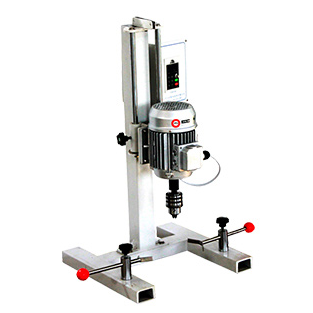
Core Function and Working Principle
The fundamental function of a lab disperser is to transform a solid-liquid mixture from a coarse, agglomerated state into a uniform, fine dispersion. The key working component is a high-speed rotating shaft equipped with a specially designed dispersion disc (often with serrated edges). When the disc rotates at high speeds (typically up to 8000 rpm), it creates a strong suction that draws the liquid and solid particles into the disc area. The serrated edges generate intense shear forces, turbulence, and cavitation, which effectively break apart particle agglomerates and distribute them evenly throughout the liquid medium.
This process is controlled by several critical parameters: rotation speed, processing time, and the geometry of the dispersion disc. Higher speeds produce stronger shear forces, leading to finer particle sizes but also generating more heat. The processing time must be optimized to achieve the desired fineness without over-dispersing. The lab disperser is typically equipped with a digital display for precise speed control and data recording, making it ideal for experimental reproducibility and process scale-up studies.
Key Components and Types
While the basic design of a lab disperser is simple, it can be configured with different working heads to suit various applications. The most common type uses a standard toothed dispersion disc for general mixing and dispersing. For more demanding applications, such as high-viscosity materials or emulsification, the lab disperser can be equipped with a high-shear rotor-stator head or a grinding wheel. This modular design allows a single machine to perform multiple functions, including dispersing, stirring, and even grinding.
Some lab dispersers also feature a lifting mechanism (manual or hydraulic) to easily raise and lower the dispersion head into the container, facilitating batch handling and cleaning. The main components include a robust motor, a variable-speed drive, a stainless steel shaft, and interchangeable dispersion tools. The materials of construction are chosen to be chemically resistant and easy to clean, ensuring no cross-contamination between batches.
Key Performance Indicators and Selection Criteria
When selecting a lab disperser, consider the following performance indicators:
- Processing Capacity: Lab dispersers typically handle volumes from 0.2 liters to 20 liters, depending on the model. The HFS-S400 model, for example, handles 0.2-5 liters, while the HFS-S1100 handles 2-20 liters.
- Speed Range: Most lab dispersers offer a variable speed range from 0 to 8000 rpm, providing flexibility for different materials and viscosities.
- Power and Torque: Motor power (e.g., 400W or 1100W) determines the machine's ability to handle high-viscosity pastes. Higher power is needed for thicker materials.
- Dispersion Disc Size: The disc diameter (e.g., 50mm, 80mm, 100mm) affects the shear rate and the volume of material that can be processed.
- Ease of Cleaning and Maintenance: Look for designs with quick-release shafts and interchangeable parts that are easy to disassemble and clean.
- Automation and Data Logging: Digital displays and programmable speed control help standardize procedures and improve reproducibility.
For laboratories that require both dispersing and grinding capabilities, models that come with both dispersion discs and grinding wheels (like the HFS-S400) are ideal. For larger batches or higher viscosity, the more powerful HFS-S1100 without grinding capability may be preferred.
Applications and Selection Advice
Lab dispersers are widely used in the formulation and quality control of paints, inks, coatings, pigments, dyes, adhesives, cosmetics, pharmaceuticals, and food products. They are essential tools for developing new recipes, optimizing dispersion processes, and scaling up from laboratory to production.
For general mixing and dispersing of low-to-medium viscosity materials, a standard lab disperser with a toothed disc is sufficient. For high-viscosity pastes or emulsification, consider a model with a high-shear head. For laboratories that also need to perform fine grinding, choose a model with interchangeable grinding wheels. Always ensure the machine's speed range and power match your typical material viscosity and batch size.