
What is a Hydraulic Dual-Shaft Disperser? A High-Efficiency Dispersing and Mixing Equipment for Medium to High Viscosity Materials
What is a Hydraulic Dual-Shaft Disperser?
At its core, a hydraulic dual-shaft disperser is a professional mixing and dispersing device that chemical, coating, ink, adhesive, and pharmaceutical industries use to efficiently break down agglomerates, disperse powders, and homogenize viscous formulations. It combines two independently driven agitators—a slow-speed anchor and a high-speed disperser—to handle materials that single-shaft machines struggle with, typically in the medium to high viscosity range (up to several hundred thousand centipoise).
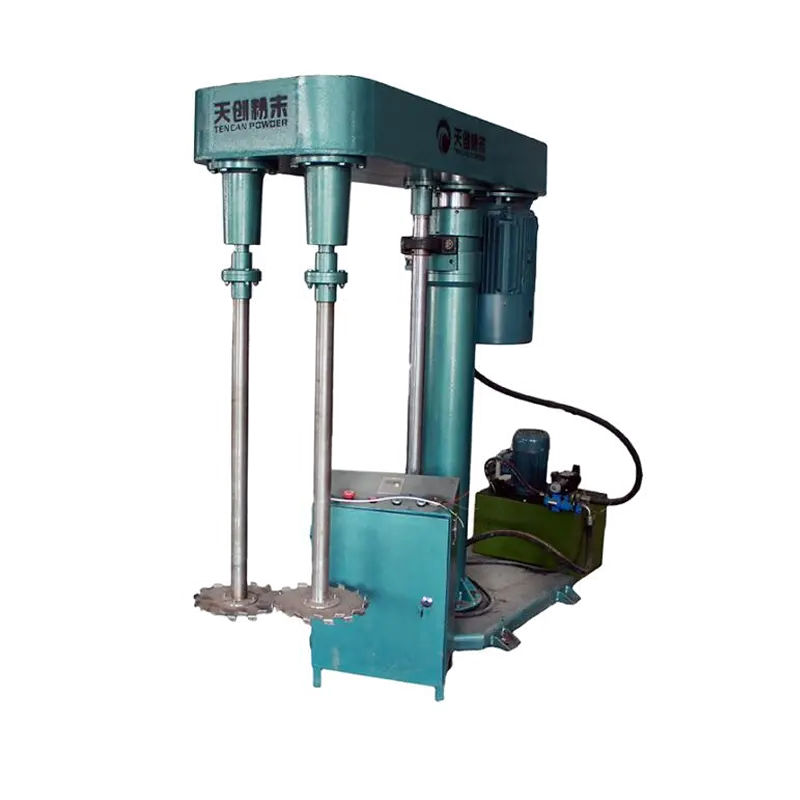
Core Function and Working Principle
The hydraulic dual-shaft disperser transforms raw materials from a coarse, lumpy, or separated state into a uniform, fine, and stable dispersion or emulsion. The equipment features two coaxial shafts: a hollow outer shaft drives an anchor-shaped stirrer that rotates at slow speed (typically 10–60 rpm), scraping the vessel walls and moving the bulk material toward the center. The inner shaft drives a high-speed disperser blade (often a toothed disc) that rotates at 800–3000 rpm, creating intense shear, turbulence, and cavitation in the material. This combination ensures that high-viscosity pastes are continuously circulated and subjected to high-energy dispersion, breaking down particle agglomerates and achieving a homogeneous mixture.
Key process parameters include the speed ratio between the two shafts, the design of the disperser blade, and the hydraulic lifting system. The hydraulic lift allows the entire agitator assembly to be raised and lowered, making it easy to clean, change containers, or adjust the working position. The vessel is often equipped with a jacket for heating or cooling to control temperature-sensitive formulations. The independent variable frequency drives for each shaft enable precise control of the mixing intensity, allowing operators to fine-tune the process for different materials.
Core Components and Key Technologies
Since the hydraulic dual-shaft disperser is a specialized type within the disperser family, its design focuses on handling high-viscosity challenges. The main components include:
- Anchor Agitator: A low-speed, close-clearance stirrer that scrapes the vessel wall and prevents dead zones, ensuring all material is circulated. Often fitted with Teflon scrapers for easy cleaning.
- High-Speed Disperser: A saw-tooth disc or similar impeller that rotates at high speed, generating the shear forces needed for dispersion.
- Hydraulic Lifting System: Allows the entire mixing head to be raised and lowered, facilitating batch handling and vessel changes.
- Variable Frequency Drives (VFD): Independent control for each shaft, enabling precise speed regulation.
- Jacketed Vessel: For temperature control via heating or cooling medium.
- Discharge Valve: Typically a flush-type bottom valve for complete drainage.
Compared to a single-shaft disperser, the dual-shaft design offers better flow and dispersion in high-viscosity materials, reducing processing time and improving product quality.
Key Performance Indicators and Selection Criteria
When selecting a hydraulic dual-shaft disperser, consider the following:
- Processing Capacity: Available in various sizes from laboratory scale (1–5 liters) to production scale (up to 2000 gallons). Choose based on batch size.
- Viscosity Range: Designed for medium to high viscosity (typically 10,000–500,000 cP). Confirm the material's viscosity matches the machine's capability.
- Speed Range: Anchor speed 10–60 rpm, disperser speed 800–3000 rpm. Variable speed control allows optimization.
- Power and Torque: Higher viscosity requires more torque. Ensure the motor and gearbox are adequately sized.
- Material of Construction: Wetted parts are often 316 stainless steel for corrosion resistance and easy cleaning. Surface finish (e.g., 100 grit) should be specified for sanitary applications.
- Automation: Look for integrated control panels with touch screens, recipe storage, and data logging for repeatable processes.
- Maintenance: Hydraulic seals, bearings, and shaft seals should be easily accessible. Consider the availability of spare parts.
Application Areas and Selection Advice
The hydraulic dual-shaft disperser is widely used in:
- Coatings, Paints & Inks: Dispersing pigments, fillers, and additives into binders.
- Adhesives & Sealants: Mixing high-viscosity formulations like epoxies, silicones, and polyurethanes.
- Pharmaceuticals & Cosmetics: Producing creams, ointments, and pastes with uniform texture.
- Chemical Industry: Preparing pastes, slurries, and viscous intermediates.
- Battery Materials: Mixing electrode slurries for lithium-ion batteries.
For laboratory R&D, a small benchtop model with 1–5 liter capacity is ideal. For pilot or production, choose a larger unit with appropriate power and vessel size. Always test your material with the manufacturer to confirm process suitability.