
What is a High-Speed Simple Disperser? A Versatile Mixing and Dispersion Equipment for Liquids and Powders
What is a High-Speed Simple Disperser?
At its core, a high-speed simple disperser is a specialized mixing and dispersion device used by industries such as paint, ink, dye, cosmetics, adhesives, and pharmaceuticals to rapidly dissolve, disperse, and homogenize solid particles into liquid vehicles. It transforms coarse, agglomerated mixtures into fine, stable suspensions by applying intense shear forces through a rotating disc.
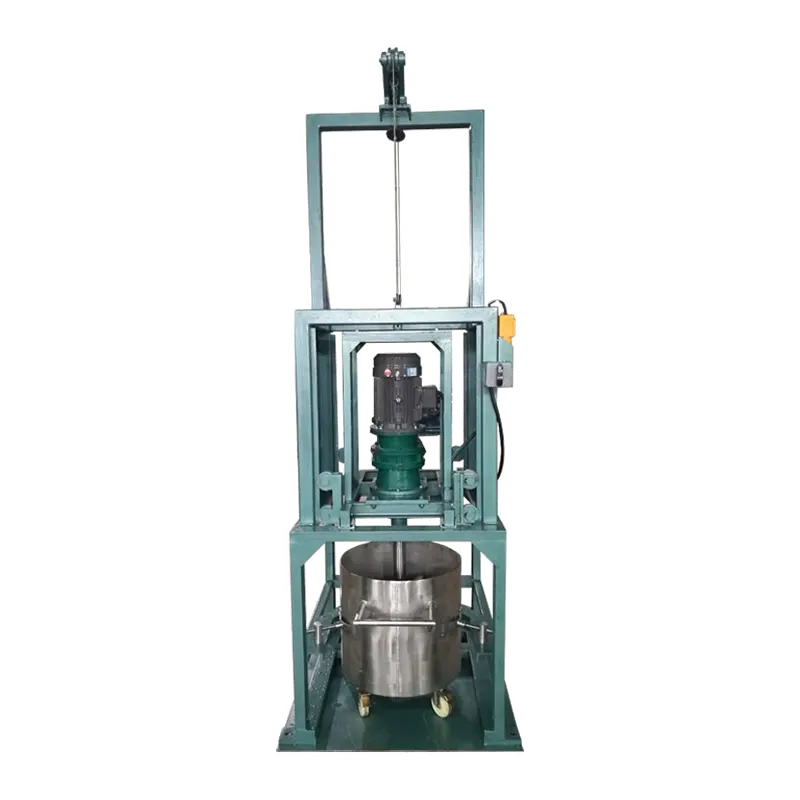
Core Function and Working Principle
The high-speed simple disperser converts electrical energy into mechanical shear energy. Its main working element is a toothed dispersing disc (impeller) mounted on a vertical shaft. When the disc rotates at high speed (typically 100–1400 rpm or higher), it creates a strong vortex in the liquid. Solid particles are drawn into the turbulent zone at the disc edge, where they are subjected to intense shear, impact, and friction forces. This breaks down agglomerates into primary particles and uniformly distributes them throughout the liquid.
Inside the mixing vessel, the fluid motion consists of two main flow patterns: a strong turbulent zone near the disc periphery (2.5–5 mm from the edge) and an upper/lower circulation flow that ensures complete turnover. The process is highly efficient, often achieving particle sizes down to a few microns in a single pass. Key parameters affecting dispersion quality include disc tip speed, residence time, material viscosity, and solid loading.
Key Components and Design Features
Although the high-speed simple disperser has a straightforward design, its components are critical for performance:
- Dispersing Disc: Usually made of stainless steel with teeth or slits. The geometry (diameter, tooth pattern) determines the shear intensity.
- Drive System: A variable-speed motor (often with frequency inverter) allows precise control of the disc speed, typically from 0 to 1400 rpm or more.
- Lifting Mechanism: Many models feature a hydraulic or manual lift to raise and lower the dispersing head, facilitating easy cleaning and vessel changes.
- Vessel / Container: The mixing vessel can be a simple open tank or a vacuum-capable sealed chamber for deaeration. Optional heating/cooling jackets are available for temperature-sensitive processes.
- Control Panel: Modern units include digital displays for speed, timer, and sometimes torque monitoring.
Key Performance Indicators and Selection Tips
When selecting a high-speed simple disperser, consider the following factors:
- Power Rating: Typically from 2.2 kW to 55 kW. Higher power handles higher viscosity and larger batches.
- Speed Range: Most units offer 100–1400 rpm. For lab use, a wider range (e.g., 0–3000 rpm) may be preferred.
- Processing Capacity: Laboratory models handle 0.5–5 liters, while production models can process up to 2000 liters or more.
- Lifting Travel: The vertical stroke (e.g., 900–1200 mm) determines the maximum vessel height.
- Material of Construction: Stainless steel (304 or 316) is standard for most applications. Explosion-proof motors and ATEX compliance are required for flammable solvents.
- Vacuum Capability: Optional vacuum lids prevent air entrainment and accelerate deaeration, critical for bubble-free coatings.
Application Areas and Selection Advice
High-speed simple dispersers are widely used in:
- Paints & Coatings: For dispersing pigments, fillers, and additives.
- Inks: Homogenizing colorants and binders.
- Cosmetics: Mixing creams, lotions, and foundations.
- Adhesives & Sealants: Dispersing thickeners and fillers.
- Pharmaceuticals: Preparing suspensions, ointments, and gels.
- Food Processing: Emulsifying sauces, dressings, and beverages.
For laboratories and small-batch production, a compact high-speed simple disperser with variable speed and a 1–5 liter capacity is ideal. For industrial scale, choose a larger model with hydraulic lift and explosion-proof features. The lab disperser series offers similar versatility for research environments.
References
For more details, please visit the product page: High-speed simple disperser.