
What is a High Speed Dispersing Homogenizer? A Versatile Dispersion and Homogenization Equipment for Liquid Materials
Introduction
At its core, a high speed dispersing homogenizer is a specialized piece of mixing and dispersion equipment that industries use to uniformly disperse, emulsify, or homogenize solid-liquid or liquid-liquid systems. It transforms coarse, agglomerated, or immiscible components into stable, fine dispersions or emulsions, often achieving particle sizes down to the nanometer range. This device is essential for laboratories and production lines where product consistency and quality depend on precise particle size reduction and uniform distribution.
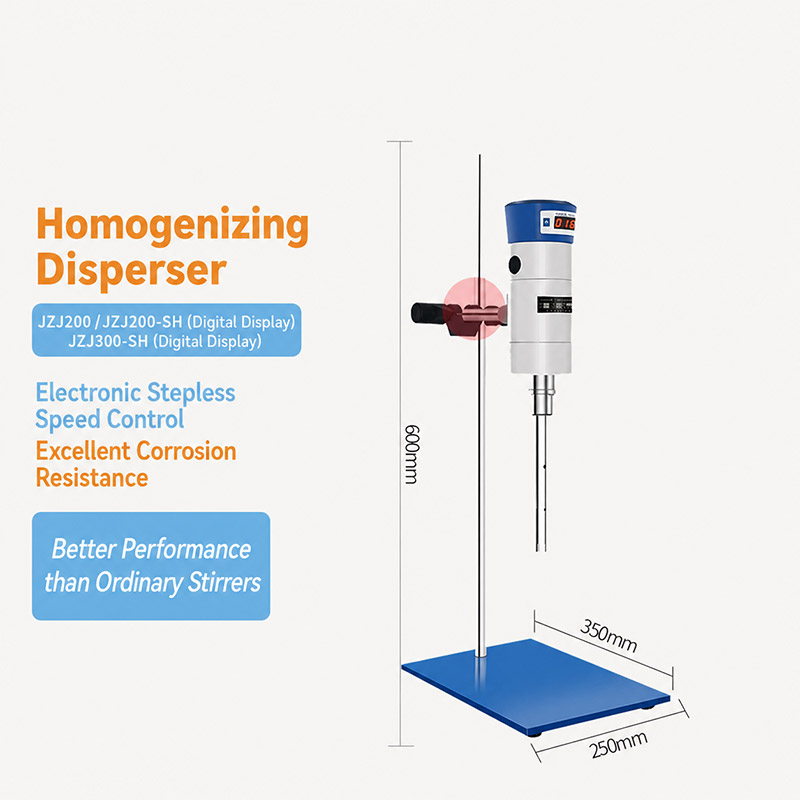
Core Function and Working Principle
The fundamental function of a high speed dispersing homogenizer is to convert a mixture from a coarse, heterogeneous state into a fine, homogeneous one. The core working mechanism involves a rotor-stator system. A high-speed rotor, turning at speeds up to 10,000–20,000 rpm or more, draws the material into a narrow gap between the rotor and a stationary stator. The intense shear forces, turbulence, and cavitation generated in this gap break down particles, droplets, or agglomerates to the desired size.
Key process parameters include rotor speed, rotor-stator gap clearance (typically 0.1–0.5 mm), residence time, and the number of passes. The rotor speed directly influences the shear rate, while the gap determines the maximum shear intensity. By optimizing these parameters, users can achieve consistent results from lab-scale trials to full-scale production, as the equipment is designed for linear scale-up.
Key Components and Technology
Modern high speed dispersing homogenizers integrate several critical components:
- Rotor-Stator Assembly: The heart of the machine. Various geometries (e.g., slotted, toothed, or conical) are available for different applications, such as fine dispersion, emulsification, or wet milling.
- Drive System: A high-power motor with variable frequency drive allows precise speed control, essential for process reproducibility.
- Sealing System: Mechanical seals (e.g., PTFE) ensure leak-free operation, especially for volatile or hazardous materials.
- Control Interface: Digital displays and programmable logic controllers enable automation and data logging for quality assurance.
For laboratory and pilot-scale applications, the equipment often features interchangeable processing modules, allowing one unit to perform multiple functions like mixing, dispersing, emulsifying, and even wet grinding. This modularity reduces the need for multiple machines and facilitates seamless scale-up.
Key Performance Indicators and Selection Criteria
When selecting a high speed dispersing homogenizer, consider the following metrics:
- Processing Capacity: Ranges from a few milliliters for lab units to thousands of liters per hour for production models. Choose based on your batch size or throughput requirements.
- Particle Size Control: The ability to achieve sub-micron or even nanometer particles. Look for machines with ultra-high tip speeds (above 40 m/s) for nano-dispersion.
- Energy Efficiency: Higher shear rates require more power, but optimal rotor-stator design can minimize energy consumption per unit of product.
- Automation: Programmable settings for speed, time, and temperature ensure repeatability and reduce operator error.
- Maintenance: Easy-to-clean disassembly and replaceable wear parts (e.g., rotor, stator, seals) lower downtime.
For example, a typical lab-scale unit may offer a rotor speed range of 500–28,000 rpm and a shear gap of 0.01–0.5 mm, enabling particle size reduction down to 50 nm. Production-scale units are linearly scalable, meaning parameters developed in the lab can be directly transferred to industrial lines without re-optimization.
Applications and Selection Suggestions
High speed dispersing homogenizers are widely used in:
- Pharmaceuticals: Preparing nano-suspensions, emulsions for drug delivery, and liposome formulations.
- Cosmetics: Producing stable creams, lotions, and sunscreens.
- Food & Beverage: Homogenizing dairy products, sauces, and beverages.
- Chemicals & Materials: Dispersing pigments, carbon nanotubes, and nanoparticles in paints, inks, and coatings.
- Biotechnology: Cell disruption and extraction of intracellular components.
For laboratory R&D, a compact benchtop model with a wide speed range and interchangeable processing heads is ideal. For pilot or production, consider a high speed dispersing homogenizer with a hydraulic lift system and larger capacity. If your process requires vacuum operation to remove air bubbles, choose a vacuum-rated model. Always verify linear scalability by testing with a lab unit before committing to a production system.