
Agate Ball Media for Ball Milling
Ball milling is often the bottleneck in sample preparation and small-batch production because the grinding media directly affect contamination, particle size distribution, and reproducibility. When a process is sensitive to iron, heavy metals, or cross-sample carryover, the choice of media becomes as important as the mill itself. Agate ball media is one of the options engineers and laboratory researchers consider when they need a non-metallic grinding medium for delicate materials. This article looks at how agate media behaves in ball mills, what process variables matter, and how to decide whether it fits a given application.
Unlike steel or tungsten carbide media, agate balls are made from a natural mineral material. That difference in composition changes the way the media interacts with the feed, the mill jar, and the final powder. For some materials, the benefit is lower contamination. For others, the trade-off is lower density and different milling kinetics. Understanding those trade-offs is the key to selecting agate media with confidence.
Why Agate Ball Media Is Used in Contamination-Sensitive Milling
Contamination is not always visible in a final powder, but it can change color, electrical behavior, catalytic activity, sintering response, or analytical results. In a ball mill, contamination can come from the grinding media, the mill jar, the lining, the feed itself, or the atmosphere. When the media wear, they release material into the sample. Metal media can introduce iron, chromium, nickel, or other elements. For laboratories working with trace analysis, advanced ceramics, or high-purity chemicals, that release can be unacceptable even at low levels.
Agate ball media is often selected because it is a non-metallic mineral material. It does not have the same metallic composition as steel or tungsten carbide media. As a result, it may reduce the risk of metallic contamination in the milled powder. The actual level of contamination depends on many factors, including the hardness of the feed, milling time, rotation speed, media quality, and the condition of the mill jar. No grinding medium is completely wear-free. Agate media can also wear over time, especially when used with hard or abrasive materials. The important point is that the wear products are different from those of metal media, which can be an advantage for certain applications.
Another reason for choosing agate media is sample compatibility. Some materials react with iron or other metals during milling. For example, certain pigments, phosphors, and electronic materials may show altered properties if metal particles are introduced. Agate is chemically stable under many conditions, so it is less likely to react with the feed. This does not make it universal. Strongly alkaline or acidic slurries, high temperatures, and aggressive chemicals can still affect natural mineral media. Process testing is always recommended before scaling up.
Laboratories also use agate media when they need to avoid cross-contamination between samples. Agate is non-porous compared with some other materials, and it can be cleaned between runs. However, cleaning effectiveness depends on the mill jar design, the cleaning procedure, and the nature of the previous sample. If a sample is sticky or reactive, a dedicated set of media and jars may be necessary.
For users who want to review a specific product option, the agate ball page provides an example of agate media intended for ball milling applications. The page can help users confirm the media type and compare it with other available grinding media.
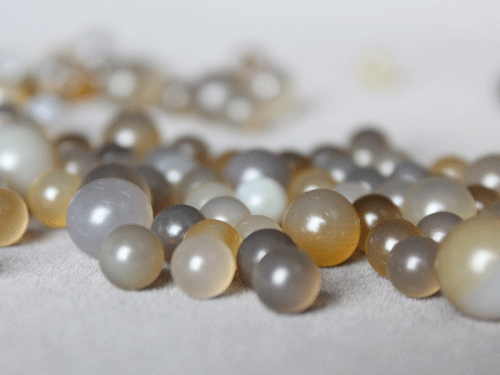
Agate ball media is a non-metallic option for contamination-sensitive milling.
How Agate Grinding Media Works in a Ball Mill
Agate media do not change the fundamental mechanics of ball milling. They still rely on impact, attrition, and shear to reduce particle size. What changes is the energy transfer and the wear behavior. Because agate is a natural mineral, its density and hardness are different from those of steel or tungsten carbide. Those differences affect how much energy is available for breakage, how quickly the feed is reduced, and how much heat is generated.
Impact, Attrition, and Shear in Tumbling Mills
In a tumbling ball mill, the jar rotates and lifts the media. At a certain speed, the media cascade or catarct. Cascading produces attrition and shear, while cataracting produces impact. The dominant mechanism depends on the rotation speed, media size, fill level, and feed properties. Agate balls participate in the same motion. However, because agate is less dense than many metal media, the impact energy per collision is lower for the same ball size and speed. That can be an advantage for materials that are sensitive to fracture or heat, but it can also mean longer milling times for hard or coarse feed.
Attrition is often the main mechanism in fine grinding. As the balls rub against each other and against the jar wall, they create shear forces that break down particles. Agate media can be effective in this regime, especially when the goal is to reduce a material that is already relatively fine. If the feed is coarse or very hard, the lower impact energy of agate may make it slower than denser media. In that case, a different media type may be more efficient, or the process may need a pre-crushing step.
Density, Hardness, and Energy Transfer
Media density affects the kinetic energy of the balls. Denser media carry more energy at the same speed, which generally leads to faster breakage. Agate has a lower density than steel and tungsten carbide, so it transfers less energy per impact. This does not mean agate cannot grind; it means the process may need more time, a higher rotation speed, or a different ball size distribution to achieve the same target particle size. The right balance depends on the feed material and the target particle size distribution.
Hardness also matters. If the media are softer than the feed, the media will wear quickly and the grinding efficiency will drop. Agate is harder than many soft minerals and chemicals, but it is not harder than all materials. When the feed contains hard phases such as quartz, corundum, or certain carbides, agate media may experience accelerated wear. In those cases, the user should consider whether a harder media type is more economical, even if it introduces a different contamination profile.
It is also important to consider the mill jar and lining material. If the jar is much harder or softer than the media, wear may concentrate on one component. A well-matched system distributes wear more evenly. For agate media, an agate jar or a compatible ceramic jar is often used in laboratory settings. This combination helps maintain a consistent contamination profile and avoids unexpected wear from mismatched materials.
Wet Milling vs Dry Milling with Agate Media
Agate media can be used in both wet and dry milling, but the behavior differs. In wet milling, a liquid carrier helps disperse the particles, control temperature, and reduce dust. The liquid can also reduce friction and wear, which may extend media life. However, the liquid must be compatible with agate and with the feed. Water is common, but some materials require organic solvents or pH-controlled solutions. In those cases, the user should verify chemical compatibility before running the mill.
In dry milling, the absence of liquid can lead to more impact and more dust. Particles may stick to the media and the jar wall, especially if the material is soft, sticky, or highly charged. Dry milling with agate media can be effective for brittle materials, but it often requires attention to fill level, rotation speed, and milling time. A small amount of process aid may help, but any additive must be acceptable for the final product.
Wet milling is often preferred when the target particle size is very fine or when the material is heat-sensitive. The liquid helps remove heat and prevents the powder from caking. Dry milling is preferred when the final product must remain dry or when a liquid carrier would be difficult to remove. The choice depends on the material, the downstream process, and the acceptable level of contamination.
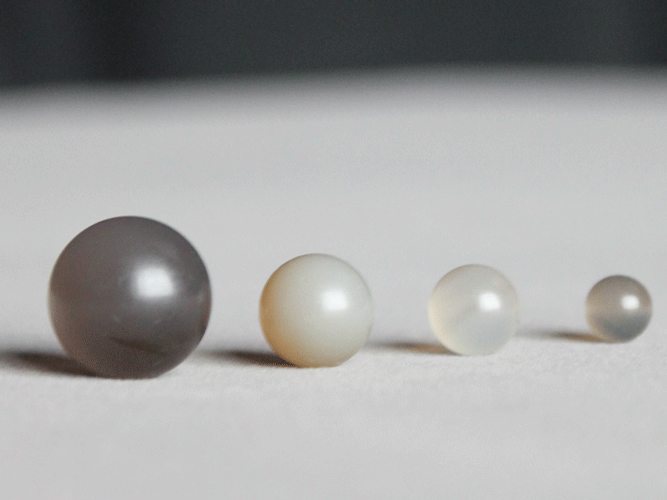
Agate media can be used in wet or dry ball milling, depending on material and process requirements.
Selection Factors for Agate Ball Media
Choosing agate media is not only a question of material. The ball size, size distribution, fill ratio, jar type, and operating parameters all influence the result. The following sections outline the main factors to evaluate before committing to a process.
Feed Material Hardness and Brittleness
The first question is whether the feed is compatible with agate. Agate is a natural mineral, and its wear resistance is finite. Soft to medium-hard materials are generally easier on agate media. Hard, abrasive materials can cause faster wear and may reduce the economic benefit. If the feed is very hard, the user should consider whether a denser or harder media is more suitable, even if it introduces a different contamination risk.
Brittleness also matters. Brittle materials fracture more easily under impact, so they may grind faster. Ductile or fibrous materials tend to deform rather than fracture, which can make ball milling less effective regardless of media type. Agate media can still be used for some ductile materials, but the process may require longer times or a different milling strategy.
Ball Size, Distribution, and Fill Ratio
Ball size affects both impact energy and the number of contact points. Larger balls have more mass and can break larger particles, but they also create fewer contact points. Smaller balls provide more contact points and better attrition, which is useful for fine grinding. A mixture of ball sizes can balance impact and attrition. The optimal distribution depends on the feed size and the target particle size.
Fill ratio is another key variable. If the jar is underfilled, the media do not interact efficiently, and the milling rate drops. If the jar is overfilled, the media cannot move freely, and energy transfer is reduced. A common starting point is to fill the jar with media to a level that allows tumbling without crowding. The exact value should be adjusted through testing.
Mill Jar and Lining Compatibility
The mill jar material should be compatible with the media and the feed. Agate media are often paired with agate jars in laboratory mills, but other ceramic jars may also be suitable. The important point is to avoid a mismatch that causes excessive wear or contamination. For example, a hard jar with soft media may wear the media quickly, while a soft jar with hard media may wear the jar. Both situations can introduce unwanted particles into the sample.
Jar shape and internal design also affect milling. A smooth cylindrical jar with rounded corners promotes smooth tumbling. A jar with sharp corners may trap material and cause uneven wear. If the jar has a lid or gasket, the user should ensure that the sealing material is compatible with the process and does not contribute to contamination.
Rotation Speed, Time, and Energy Input
Rotation speed controls the motion of the media. At low speeds, the media cascade and produce attrition. At higher speeds, they catarct and produce impact. If the speed is too high, the media may centrifuge against the jar wall and stop doing useful work. The critical speed depends on the jar diameter and the media. Agate media, being less dense, may behave differently from metal media at the same speed. Users should adjust speed based on observed milling performance, not just a fixed setting.
Milling time is another variable. Longer milling generally produces finer particles, but it also increases wear, heat, and contamination risk. There is usually a point of diminishing returns where additional time does not significantly reduce particle size. Monitoring particle size distribution during a trial can help identify the practical endpoint.
Contamination Control and Cleaning Protocol
Even with agate media, contamination control requires good practice. The jar and media should be clean before each run. Cleaning methods depend on the previous sample and the next sample. For many laboratory applications, rinsing with water or a compatible solvent, followed by drying, is sufficient. However, if the previous sample contained heavy metals or organic residues, more thorough cleaning may be needed. In some cases, a dedicated set of media and jars for a specific material is the safest approach.
It is also important to inspect media regularly. Chipped or cracked agate balls should be replaced because they can shed fragments and affect milling consistency. Worn media may also change the milling kinetics. A simple visual inspection before each run can prevent unexpected contamination.
| Selection Factor | What It Affects | Practical Consideration |
|---|---|---|
| Media material | Contamination profile, wear rate, chemical compatibility | Agate is non-metallic; confirm compatibility with feed and liquid |
| Ball size | Impact energy, number of contact points, particle size distribution | Use larger balls for coarse feed, smaller balls for fine grinding |
| Fill ratio | Media motion, energy transfer, milling efficiency | Avoid underfilling and overfilling; optimize through trials |
| Jar material | Wear balance, contamination, sample compatibility | Match jar with media; agate jar is a common laboratory choice |
| Rotation speed | Milling mechanism, heat generation, media motion | Adjust to avoid centrifugation and excessive wear |
| Milling time | Particle size, contamination, throughput | Monitor particle size; stop at practical endpoint |
Understanding Milling Kinetics with Agate Media
Milling kinetics describe how quickly a material is reduced to the target particle size. With agate media, kinetics are influenced by the lower density compared with metal media, but also by the shape, size, and surface condition of the balls. A useful way to think about kinetics is to separate breakage into two stages: coarse grinding, where impact dominates, and fine grinding, where attrition dominates. Agate media may be less aggressive in the coarse stage, but they can still perform well in the fine stage if the process is set up correctly.
Role of Media Density in Breakage Rate
Media density determines how much kinetic energy is available at a given rotation speed. Higher density means more energy per collision, which can increase the breakage rate for hard or coarse particles. Agate media have lower density than steel, so the breakage rate may be slower for the same ball size and speed. This is not necessarily a disadvantage. Lower energy can reduce over-grinding, limit heat generation, and protect heat-sensitive materials. The trade-off is that the user may need to increase milling time or adjust the ball size distribution to reach the target particle size.
Particle Size Distribution and Grinding Limit
Every ball milling process has a practical grinding limit. As particles become finer, they become harder to break because defects become smaller and interparticle forces become more significant. Agate media can help reach fine sizes, but the limit depends on the material, the media size, and the milling energy. If the target is below the practical limit, the process may stall regardless of media type. In that case, a different milling technology or a combination of methods may be required.
How Feed Size Distribution Affects Performance
The feed size distribution affects how the media interact with the material. A narrow feed distribution is easier to mill consistently. A wide distribution means that some particles break quickly while others remain coarse. Agate media can handle a range of feed sizes, but the ball size distribution should be selected to match the feed. If the feed contains large particles, larger balls may be needed to initiate breakage. If the feed is already fine, smaller balls can improve attrition and narrow the final particle size distribution.
Material Compatibility and Chemical Resistance
Agate is a natural mineral, and like all materials, it has limits. Chemical compatibility is important when the milling process involves liquids, pH extremes, or reactive additives. Even if the media are mechanically suitable, chemical attack can cause surface degradation, contamination, or premature wear.
pH and Solvent Effects
Strongly acidic or alkaline slurries can affect natural mineral media over time. The severity depends on the concentration, temperature, and duration of contact. Organic solvents are often less aggressive, but they can still interact with the media surface or with the jar materials. Before using agate media in a wet process, the user should verify compatibility with the specific liquid and any dissolved additives.
Temperature Effects
High temperatures can accelerate chemical reactions and thermal stress. Ball milling generates heat, and if the process is exothermic or the mill is operated at high speed for long periods, the temperature inside the jar can rise. Agate media may be suitable for moderate temperatures, but extreme conditions should be avoided unless testing confirms otherwise. Cooling the jar or using intermittent milling can help manage temperature.
Reactive Materials
Some materials react with silica or silicate minerals. If the feed contains components that can react with agate, the media may not be appropriate. In these cases, a different media material may be required. The best approach is to run a small-scale compatibility test before committing to a full batch.
Common Problems and Practical Adjustments
Even with a suitable media choice, ball milling can run into problems. The following issues are common when using agate media, along with possible adjustments. These are general guidelines; the right solution depends on the specific material and equipment.
Slow Particle Size Reduction
If the particle size is not decreasing as expected, the first step is to check the basics. Is the jar loaded correctly? Is the rotation speed appropriate? Are the balls the right size? With agate media, the lower density compared with metal media can make impact breakage less effective. If the feed is coarse, a pre-crushing step or a larger ball size may help. If the feed is fine but the target is very small, increasing milling time or using a smaller ball size may improve attrition. In some cases, a different media type may be more efficient, but that decision should consider contamination requirements.
Media Wear or Breakage
Agate media can wear or break if the feed is too hard, the speed is too high, or the jar is mismatched. Chipped balls should be removed. If wear is excessive, the user should review the feed hardness, rotation speed, and fill ratio. A softer feed or a lower speed may extend media life. If the application requires grinding a very hard material, agate may not be the most economical choice. In that case, a harder media may be better, provided the contamination profile is acceptable.
Sticking and Sample Loss in Dry Milling
Dry milling can cause particles to stick to the media and jar wall. This is especially common with soft, sticky, or electrostatically charged powders. The result is sample loss and inconsistent milling. Possible adjustments include reducing the fill ratio, lowering the rotation speed, or adding a small amount of a compatible process aid. If the material is very sticky, wet milling may be a better option. The choice depends on whether a liquid can be used in the process.
Heat Generation and Temperature Control
Ball milling generates heat through friction and impact. Agate media generate less heat per impact than denser media, but heat can still accumulate in long runs or high-speed operations. If the material is heat-sensitive, the user should consider shorter milling intervals, lower speeds, or a cooled mill jar. Wet milling can also help control temperature because the liquid absorbs heat. Temperature monitoring during a trial is recommended for sensitive materials.
For reference, the agate grinding media page shows an example of the product and its context within a broader grinding media range. Reviewing the product information can help users confirm whether the media format and material are appropriate for their mill setup.
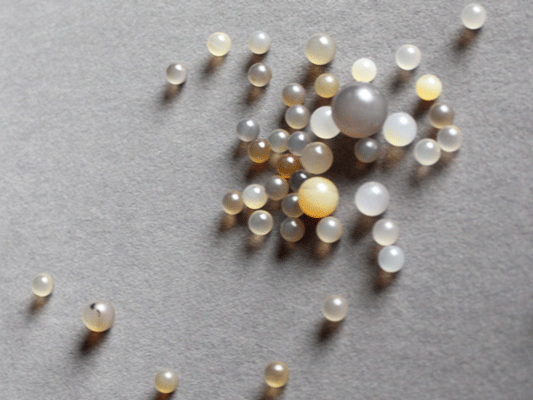
Agate balls should be inspected regularly for chips or wear before use.
Application Scenarios for Agate Ball Media
Agate media are used in laboratories and small-scale production where contamination control and material compatibility are important. The following scenarios are common, but each application should be tested to confirm performance.
In geological and mineral sample preparation, agate media are often used because they reduce the risk of introducing metal contamination that could interfere with elemental analysis. The feed may include rocks, minerals, or soils. Depending on the hardness of the sample, agate may be suitable for fine grinding after a preliminary crushing step.
In ceramic and glass research, agate media can be used to mill raw materials, frits, or additives. The non-metallic composition helps maintain the purity of the final powder. However, if the material is very hard, wear may be higher, and a different media may be considered.
In pigment and coating development, agate media can help disperse and reduce particle size without introducing metal ions that might alter color or stability. Wet milling is common in these applications because the pigment is often processed in a liquid carrier.
In battery and electronic materials research, contamination can affect electrochemical performance. Agate media may be used for small-scale milling of active materials or precursors. The user should verify that the media and jar do not react with the material or the electrolyte. In many cases, a glovebox or inert atmosphere may also be required.
In chemical and pharmaceutical laboratories, agate media can be used for milling crystalline materials, catalysts, or excipients. The key considerations are chemical compatibility, cleaning, and prevention of cross-contamination. A dedicated set of media and jars is often preferred for regulated work.
Scale-Up from Lab to Pilot Production
Scaling up a ball milling process is not simply a matter of using a larger jar. Media motion, energy input, and heat removal change with scale. When moving from a laboratory mill to a larger mill, the goal is to maintain similar grinding conditions. This often means adjusting rotation speed, media size, and fill ratio to keep the energy per unit mass within a similar range.
Similarity Rules and Practical Limits
Similarity rules can provide a starting point, but they are not exact. The behavior of agate media in a small jar may differ from a larger jar because the media bed depth and the number of contact points change. A practical approach is to run a pilot batch with the same media material and then compare particle size distribution, media wear, and temperature. If the results differ, adjust one variable at a time.
Media Filling and Power Draw
In larger mills, media filling affects power draw and milling efficiency. Agate media are lighter than metal media, so the power draw may be lower for the same volume. This can be an advantage for energy consumption, but it also means that the milling energy per unit mass may be lower. The user may need to increase milling time or adjust the media size to compensate.
Cooling and Process Control
Heat removal becomes more important at larger scales because the surface-to-volume ratio decreases. If the process is heat-sensitive, a cooled jar or a continuous milling system may be necessary. Temperature sensors and process controls can help maintain consistent conditions. For agate media, avoiding excessive temperature also helps reduce wear and chemical interaction.
Maintenance and Media Life
Agate media are a consumable item. Their life depends on the feed, operating conditions, and handling. Good maintenance practices can extend media life and improve process consistency.
Inspection
Inspect agate balls before each run. Look for chips, cracks, discoloration, or uneven wear. Damaged balls should be removed because they can break during milling and contaminate the sample. If many balls show wear, consider replacing the set or adjusting the process to reduce wear.
Storage
Store agate media in a clean, dry place. Avoid mixing media from different materials or from different applications unless they have been thoroughly cleaned. Proper storage reduces the risk of contamination and physical damage.
Replacement
Replace agate media when wear becomes significant or when milling performance drops. Keeping a record of media life and process conditions helps predict replacement intervals. In critical applications, a dedicated set of media should be reserved for a specific material to avoid cross-contamination.
How to Evaluate Agate Media in Your Process
A structured trial is the best way to determine whether agate media are suitable. The goal is to compare agate media against the current media or against a baseline process while controlling other variables. A simple trial plan can include the following steps.
First, define the target. What particle size distribution is required? What is the acceptable contamination level? What throughput is needed? These criteria will determine whether the trial is successful.
Second, prepare the feed consistently. Use the same feed material, particle size, and moisture content for each test. If the feed varies, the results will be difficult to interpret.
Third, set the mill parameters. Record the jar type, media size, fill ratio, rotation speed, milling time, and any liquid or additive. Keep these parameters constant during the trial unless they are the variable being tested.
Fourth, measure the results. Particle size distribution can be measured by laser diffraction, sieving, or microscopy, depending on the target size. Contamination can be checked by elemental analysis if required. Also note media wear, temperature rise, and sample recovery.
Fifth, compare and iterate. If the results are close but not sufficient, adjust one variable at a time. For example, increase milling time, change the ball size distribution, or adjust the fill ratio. If the media wear is too high, consider whether a different media material is more appropriate.
Finally, document the trial. A written record helps with scale-up and with future process decisions. It also provides evidence for quality systems if the process is regulated.
Frequently Asked Questions
What is agate ball media made from?
Agate ball media is made from agate, a natural mineral material. It is non-metallic, which is why it is often considered for applications where metallic contamination is a concern. The exact composition and properties can vary by source and grade, so users should review the supplier's product information.
Can agate balls grind hard materials?
Agate balls can grind some hard materials, but wear may increase as feed hardness increases. For very hard or abrasive materials, a denser or harder media may be more efficient. The decision should consider both milling performance and the acceptable contamination profile.
How do I choose between agate and other grinding media?
Start with the requirements: contamination limits, feed hardness, target particle size, and throughput. Agate media are a good candidate when metallic contamination must be minimized and the feed is compatible with a natural mineral media. If the feed is extremely hard or the required milling energy is high, other media may be more suitable.
How should agate grinding media be cleaned?
Cleaning depends on the previous sample and the next sample. For many laboratory applications, rinsing with water or a compatible solvent and then drying is sufficient. If the previous sample contained heavy metals or organic residues, more thorough cleaning or a dedicated set of media may be needed. Always inspect the media for chips or cracks after cleaning.
Can agate media be used in wet milling?
Yes, agate media can be used in wet milling, provided the liquid is compatible with agate and with the feed material. Wet milling helps control dust and temperature, but the user should verify that the liquid does not react with the media or the sample. Cleaning and drying after wet milling are also important.
What ball size should I use with agate media?
Ball size depends on the feed size and the target particle size. Larger balls provide more impact energy for coarse feed, while smaller balls provide more contact points for fine grinding. A mixture of sizes can balance both mechanisms. The best distribution should be determined by testing.
Practical Takeaways for Agate Ball Milling
Agate ball media is not a universal solution, but it fills an important role in contamination-sensitive milling. The main advantages are its non-metallic composition and its compatibility with many laboratory and small-scale processes. The main limitations are lower density and finite wear resistance compared with some other media. Understanding these trade-offs helps users decide when agate is the right choice.
Before running a production batch, test the media with the actual feed. Confirm that the mill jar and lining are compatible. Check that the cleaning procedure is adequate for the next sample. Monitor media wear and replace damaged balls. Adjust ball size, fill ratio, speed, and time based on measured results, not assumptions. With a structured approach, agate media can support reliable particle size reduction while helping control contamination.
For more details on the product format and available options, review the agate ball product page. It provides a starting point for evaluating whether agate media fits your mill and your material.